Connecting to prior knowledge
NOTE: All page references are from the 2012 edition of Dragonkeeper published by Walker Books Australia.
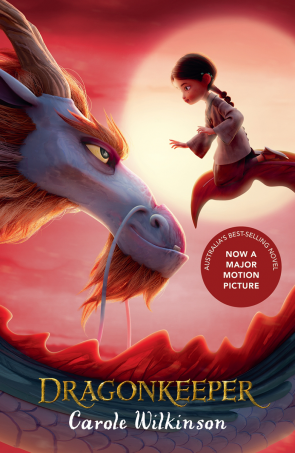
Carole Wilkinson’s Dragonkeeper is set in ancient China during the Han Dynasty, in the year 141 BCE. It tells the story of an 11-year-old slave girl who frees the last surviving imperial dragon from captivity. As they flee for their lives, the dragon (Long Danzi) gives the girl her name (Ping) and entrusts her with the care of a mysterious dragon stone. This is an intriguing story about a girl who, despite not believing in her own worth, finds the strength and courage to become a true Dragonkeeper.
Make sure you are familiar with the Glossary and Pronunciation pages (pp. 344–346) at the back of the book, as students will encounter many new words as they read the book.
Building the field
The Han Dynasty
To build students’ field knowledge of the Han Dynasty, explore some of the following links:
List some of the Chinese words encountered in these resources, and discuss the phoneme/grapheme relationships when Standard Chinese words are written in pinyin (the official system of spelling Chinese sounds using the English alphabet). For example:
| Shang | Zhou | Qin | Han | Xin |
| Shihuangdi | Liu Bang | Wang Mang | Chang’an | Luoyang |
| Xiongnu | Fu | Lishu | Shou wen | Mingqi |
| I Qing | Shijing | Shujing | Li Qi | Chunqiu |
If possible, arrange a visit from a teacher, parent, or other member of the school community who speaks Mandarin Chinese to help with this part of the lesson. You can also search for and listen to different sounds using this interactive pinyin chart.
There is a lot of information in these resources. Make sure you are familiar with them (and any others that you choose to explore) so you can support students to answer some comprehension questions. Ask a mixture of literal, inferred, and evaluative questions, such as:
| Literal questions | Who was Liu Bang and what did he do?
Which philosophy was adopted as the official state doctrine? What were some inventions or innovations from this period? |
| Inferred questions | Why is the Han Dynasty considered a ‘golden age’ in Chinese history?
How did learning and education change during this period? |
| Evaluative questions | What were the pros and cons of the Silk Road? |
Students can respond in writing or through a whole class discussion.
Dragons
Dragons are important symbols in Chinese culture. Explore some of the following links to learn more about Chinese dragons and plan for literal, inferred, and evaluative comprehension questions:
- Chinese Language Institute – Chinese Dragons: Their Types, History, and Significance
- China Highlights – Chinese Dragons: Facts, Culture, Origins, and Art
- China Educational Tours – Dragon in Chinese Mythology
- China Travel – Chinese Dragon: Symbols, Facts, Methodology
- The Royal Mint – The Dragon in Chinese Culture
Wilkinson has compiled a dragon tour that maps the presence of dragons in Melbourne’s CBD. You can follow her directions on foot, if practical, or use them in conjunction with Google Street View.
Dragons may also appear in your local community as statues, on the outside of buildings, or in other forms of art and decoration. Ask students to look for dragons in their community and bring a photo to class. Alternatively, they can research famous landmarks or artworks featuring dragons (both locally and further afield) and bring a picture of one to discuss in class.
Reading and brainstorming
Present students with a range of books about dragons. Some may be available in your school or local library. Examples include:
- The Dragon Atlas: Legendary Dragons of the World by Anna Claybourne, illus. Pham Quang Phuc
- The Truth About Dragons by Julie Leung, illus. Hanna Cha
- Paper Dragons: The Fight for the Hidden Realm by Siobhan McDermott, illus. Yuzhen Cai
- Our Family Dragon: A Lunar New Year Story by Rebecca Lim, illus. Cai Tse
- All About Dragons by Izzy Quinn, illus. Kristina Kister
- City of Dragons: The Awakening Storm by Jaimal Yogis, illus. Vivian Truong
You may also be able to find a copy of Wilkinson’s own encyclopedia of dragons, The Dragon Companion.
As students engage with these texts, ask them to provide an oral summary of what they have learnt. Add their ideas to a brainstorming map that shows how the information connects across various resources. When a new idea is introduced, add a new bubble to the map. If the same idea appears multiple times, annotate the map with the details of the relevant sources. The focus should be on helping students to summarise ideas from a text and connect one source to another.
Art activities could also be added to your program to create dragon displays. Red Ted Art, Super Simple, and Happy Wabby have some good options.
Exploring the text in the context of our community, school, and ‘me’
Identity: our name, our culture, our family
At the beginning of Dragonkeeper, Ping does not know her own name. Names are a very important part of our identity. To set the scene, show students The Name Jar by Yangsook Choi and read the blurb on the publisher’s website. Then read the book aloud, if available, or watch the read-aloud by Choi herself.
Afterwards, present students with some or all of the following questions. They can discuss their answers in pairs, small groups, or as a whole class.
- Why does Unhei choose not to share her name? How does her class react?
- Have you ever had to move to a different place or change schools? How did you feel?
- Have you ever been somewhere you didn’t know anyone and had to try to make new friends? How did you feel?
- Why does Unhei’s class create the name jar?
- Would you have made the same choice as Unhei at the end? Why or why not?
Ask students if they know the meaning of their own names. Have them do some research to confirm or find out. They can then write their name on a piece of paper and draw a picture to symbolise its meaning. Create a class display of names and associated name symbols.
The Boy Who Tried to Shrink His Name* by Sandhya Parappukkaran, illustrated by Michelle Pereira, is another excellent text that explores the connection between names and identity.
* Reading Australia title
Social structure: then and now
Australia is often described as an egalitarian society. This means that all people are considered equal and are entitled to the same rights and opportunities, regardless of their background. This was not the case in ancient China, which followed a strict class system based on the jobs people performed. There were four main social groups, plus two others at the very top and bottom of the hierarchy: the Emperor and royal family, and slaves.
Slavery is the condition in which one person owns another person. An enslaved person is treated as property and forced to work without pay or freedom. Slavery existed throughout the ancient world and still exists in some forms today. In ancient China, it was not unusual for families facing poverty or other hardships (e.g. famine) to sell their children into slavery. This is how Ping comes to be in Master Lan’s service before the events of Dragonkeeper (see p. 2).
NOTE: This article will be useful for teachers, but should not be shared directly with students as it contains some mature references.
By contrast, the Emperor was the most powerful person in ancient Chinese society. He enjoyed an elevated position thanks to the ‘mandate of heaven’, which gave him a sacred right to leadership. As a result, he commanded total respect and obedience from everyone under his rule.
Ping meets two Emperors over the course of Dragonkeeper: the young Liu Che, who will grow up to be Emperor Wu, and his father, Emperor Jing. This short clip (from a longer video by ClickView) will help contextualise Ping’s interactions with the Emperors, particularly in Chapter Three (pp. 30, 33–43). You might like to discuss how leadership in ancient China differs from leadership as we know it in contemporary Australia. For both the Emperor and the Prime Minister, consider:
- Who gets to be in this role?
- What are they responsible for doing?
- Who or what gives them the authority to lead?
- How much freedom do people have under this leader?
Rich assessment task
To consolidate what they have learned so far, have students complete an individual reflection using the think, puzzle, explore routine. They should reflect on the following:
- What do you think you know about ancient China and/or dragons so far?
- What questions or puzzles do you have about these topics?
- How can you explore these questions further?
Students can discuss their responses in small groups, and then in a whole class discussion.
Finish by asking students to predict what Dragonkeeper might be about. From this point you can commence daily reading of the text.
Responding to the text
Introduce Dragonkeeper by reading the title and blurb aloud. Students will notice that it is the first book in a series; you can view the other titles on Wilkinson’s website.
Begin by exploring the Pronunciation guide on p. 346. Practise the sounds together and encourage students to use the correct pronunciation while reading and discussing the book.
Read p. 1 and jointly complete a T-chart to record what students know and can infer about the slave girl and Master Lan. Identify the similarities and differences between these two characters. Then read the rest of Chapter One (pp. 2–14). Once you have finished, return to the T-chart to confirm or revise students’ earlier observations and inferences.
Genre: historical fiction
Ask the class what type (genre) of story they think Dragonkeeper is. Guide the discussion towards historical fiction. This is a genre of texts that are set in the past, and may feature real people and places, but have a made-up plot and characters. These books encourage the reader to explore history and are often full of big adventures.
Collect some examples of historical fiction for your class library such as All the Beautiful Things* by Katrina Nannestad, Tigg and the Bandicoot Bushranger* by Jackie French, or The Year the Maps Changed* by Danielle Binks. Readings also has a collection of historical fiction for children. These can be used for wide reading and/or text comparison.
* Reading Australia title
To explore this genre further, create a mind map or retrieval chart with the following headings:
| History | Locate the real historical people, places, etc. in the story |
| Fantasy | List the elements of the story that are imagined |
| Adventure | List the elements of the story that are adventurous |
| Culture | Locate the aspects of ancient Chinese culture in the story |
You can use a Padlet or other collaborative tool to capture students’ ideas. This can be an ongoing activity that students work on as they progress through the book.
Examining sentences
Read Chapters Two (pp. 15–21) and Three (pp. 22–43). Then return to pp. 27–28 and focus on the long paragraph that describes the dragon’s appearance.
Copy each sentence from this paragraph onto a new sentence strip and number them in order. This will make it easier to talk about particular sentences. Lead a class discussion in which you ask students to identify structural patterns in the text. For example:
| Question | Possible answers |
| How do many of the sentences start? | By naming the focus of that sentence (e.g. head, whiskers, body). |
| Which sentences offer a comparison? | e.g. Sentence #3 (body like a snake) |
| Which sentences offer a description? | e.g. Sentence #5 (height) |
| How do the sentences work together in a paragraph? | They help us to clearly visualise what the dragon looks like. In cinematography terms, Wilkinson ‘zooms in’ on the dragon, starting with an overall picture and then focusing on specific features from head to toe. |
Exploring plot, character, setting, and theme
Timeline
Once you have read at least up to the end of Chapter Seven (pp. 83–99), support the class to track the flow and development of the plot by creating a timeline. Padlet or a similar tool would work well here. Students can add to the timeline after each chapter to summarise plot developments and support discussion and comprehension about the narrative.
This can be an ongoing activity that students work on as they progress through the book. A chapter summary (PDF, 105KB) is available for teacher use.
Themes
A theme is an important idea or underlying message that a writer explores in their work. Themes are conveyed through characters, setting, dialogue, and plot. This video will help students to understand what themes are and how to identify them.
Ask the following questions as you continue reading Dragonkeeper to assist students to explore its themes:
- What is the meaning behind this chapter?
- What lesson(s) do we learn?
- What are the key events?
- Which characters are involved (think about their qualities and actions) and how do they respond to the events of this chapter?
Use these questions to begin exploring the following themes:
- Responsibility
- Freedom
- Courage
- Greed
- Friendship
Characters
Organise small groups of students to create character profiles for:
- Ping (introduced on p. 1)
- Hua (introduced on p. 7)
- Long Danzi (introduced on p. 5)
- Diao (introduced on p. 37)
- Wang Cao (introduced on p. 115)
This can be an ongoing activity that students work on as they progress through the book. They can add information after each chapter or build profiles for other characters as they appear (e.g. Master Lan, from p. 1; the necromancer, from p. 210; Emperor Liu Che, from p. 256). You can find ideas and templates for creating character profiles online; Top Teacher has a couple of options here and here.
Authors ensure that their characters have dimension. For example, ‘good’ characters will have some weaknesses or failings that make them imperfect and potentially put the plot at risk. ‘Evil’ characters may have some sympathetic traits that make them appear more human. Discuss how Wilkinson creates dimension while also creating ‘good’ and ‘evil’ characters in Dragonkeeper.
This activity supports metacognitive strategies (see p. 26 of the High Impact Teaching Strategies document).
Rich assessment task
Display and reread the blurb for Dragonkeeper as it appears on Walker Books’ website. Take a moment to talk about some of the words that students may find interesting, such as ‘epic’, ‘perilous’, and ‘enchant’.
For this task, ask students to orally reflect on their learning about the book so far. Identify which criteria you’d like to focus on and provide guiding questions to help scaffold responses. Allow students to prepare written notes and film their responses using a device. Encourage them to self-evaluate their recording, noting where they’ve provided a quality response and where they could improve the content or presentation. Allow them to re-record their responses if desired so they are submitting their best work.
A rubric is available for this task (PDF, 55KB).
Examining text structure and organisation
Watch this Khan Academy video that explains the elements of a story. Fiction writing often follows a dramatic structure or narrative arc. The elements of a traditional narrative arc are:
| 1. Exposition | Introduces the characters and setting (time and place) |
| 2. Conflict | The big problem or inciting incident |
| 3. Rising action | When the conflict starts to escalate |
| 4. Climax | When matters come to a head |
| 5. Falling action | The aftermath of the climax |
| 6. Resolution | How the story ends |
In Dragonkeeper, these elements can also be seen in individual chapters.
Working in small groups, students can identify the narrative arc of a single chapter. You can assign everyone the same chapter or allow groups to choose their own. Each group should record the number and title of their chapter, as well as the page range. They should also read the epigraph (a quote from the upcoming chapter) and discuss its relevance to what they are about to read.
The provided scaffold (PDF, 53KB) will assist students to examine some of the elements of text structure. Finish with a whole class discussion about the narrative arc of the chosen/assigned chapters and where they fit into the overall arc of the book.
(AC9E5LA03) (AC9E5LA04) (AC9E5LY03) (AC9E5LY05)
Examining grammar and vocabulary
Figurative language
Support the class to locate, understand, interpret, and experiment with sound devices and imagery in Dragonkeeper. The following examples have been drawn from Chapter One (pp. 1–14):
| Technique | Example |
| Imagery | ‘The garden was bursting with flowers: pink, blue, pale purple, bright yellow.’ (p. 12) |
| Simile | ‘the air was so hot it was like breathing flames’ (p. 2) |
| Metaphor | ‘[The sun] was a dark orange blot on the horizon’ (p. 9) |
| Personification | ‘a few peonies struggled into flower’ (p. 12) |
| Alliteration | ‘bamboo bowl’, ‘maggoty meat’ (p. 1) |
| Onomatopoeia | ‘Snow crunched’ (p. 2) |
| Repetition | ‘Not because of the cold. Not because of the darkness. Not because of the smell of stale air’ (p. 4) |
| Rhyme | ‘from ink stones to chicken bones’ (p. 1) |
Discuss how Wilkinson uses figurative language to enrich her writing and engage readers. Then have students review their chosen/assigned chapters from the previous activity (or look through new chapters) to locate other examples in Dragonkeeper. For example:
| Page reference | Technique | Example |
| Chapter Five, p. 62 | Personification | ‘The ground raced towards them’ |
| Chapter Eight, p. 103 | Simile | ‘words poured out of him like grain from a split sack’ |
| Chapter 9, p. 128 | Onomatopoeia | ‘people shouting, ducks quacking and pigs grunting’ |
Vocabulary
Wilkinson has included a Glossary on pp. 344–345. Use this as a guide to develop a word wall, recording new and unusual words that the class comes across as they progress through the book. Discuss words with common letter patterns but different pronunciations, such as the ‘ci’ in ‘Confucius’ (versus ‘circle’, ‘city’, ‘decide’) or the ‘oe’ in ‘phoenix’ (versus ‘toe’, ‘shoe’, ‘poem’).
The definitions in the Glossary contain noun groups, consisting of a main noun and perhaps one or more adjectives. Work through some examples so that students can identify the main noun (the thing we are talking about) and any adjectives (words that describe the thing we are talking about). Most often, the adjective(s) appear before the main noun. Sometimes words appear after the main noun to give us more information; these are called qualifiers because they qualify the main noun.
In the examples below, the main noun has been underlined.
| Word | Definition | Comments |
| Cash | A Chinese [adjective] coin [main noun] of low value with a square hole in the middle [qualifier]. | The adjective has a capital letter. |
| Chang | A measure [main noun] of distance [qualifier] equal to about 2.3 metres [qualifier]. | There are no adjectives; the main noun is close to the start and there are two qualifiers. |
| Cinnabar | A bright [adjective] red [adjective] mineral [main noun] whose chemical name is mercuric sulphide [qualifier]. | There are two adjectives. |
| Confucius | A Chinese [adjective] philosopher [main noun] who lived around 500 BCE [qualifier]. | The adjective has a capital letter. |
Proverbs and wise sayings
A proverb is a short, memorable saying that expresses wisdom, advice, or an idea that is commonly held to be true. Proverbs come from a variety of sources, including oral traditions, literature, and mass media. Some common English proverbs include:
- Many hands make light work
- Strike while the iron is hot
- Honesty is the best policy
- The grass is always greener on the other side
- An apple a day keeps the doctor away
- Better late than never
- Actions speak louder than words
This Learn Bright video provides a useful introduction and breaks down some common sayings.
In Dragonkeeper, Danzi has many sayings that sound like proverbs. For example:
| Page reference | Proverb | Explanation |
| pp. 183, 184 | ‘The straight path must sometimes be crooked’ | This means that, although we will have unplanned experiences that make us feel like we are heading in the wrong direction, we will still get where we need to go.
An example might be moving house and leaving your school. This can be hard, but you will end up making new friends and enjoying your new house. Your path in life may have an unexpected twist, but things will still work out. |
| p. 203 | ‘Sometimes advancing seems like going backwards’ | This means that progress is not always linear, and that sometimes you have to retrace your steps to find the right way forward.
An example might be learning a new language or skill. It takes a lot of work, and there may be times when you feel like you have gone backwards or will be a beginner forever, but this is all part of the process of getting better. |
Look for more of Danzi’s sayings throughout the book (there is a helpful list on pp. 10–11 of Walker Books’ teacher notes). Talk about what they mean in the context of the story, and then how they might apply in real life. Examples include:
- ‘All answers lie beyond the gate of experience’ (p. 68)
- ‘Composure is the master of haste’ (p. 72)
- ‘The journey of a thousand li begins with a single step’ (p. 82)
- ‘It is because of its emptiness that the cup is useful’ (p. 121)
- ‘Recognising one’s limitations is knowledge’ (p. 127)
Many of these sayings sound like the teachings of Confucius. Confucius was a Chinese philosopher and teacher who lived from 551–479 BCE. Ping meets a young scholar on the road to Chang’an who tells her about this person (pp. 102–105, specifically 104). Use the following resources to introduce students to Confucius, his teachings, and some of his famous sayings:
- Britannica Students – Confucius
- URI – Confucianism
- Nat Geo Education – Confucianism
- ThoughtCo – 47 Confucius Quotes That Still Ring True Today
Finish by having students form small groups to discuss their understanding of proverbs and how they assist us to understand events in our lives.
Rich assessment task
In 2024, an animated film based on Dragonkeeper was released. The film shares the same basic premise as the book – Ping and Danzi travelling across ancient China in service of the dragon stone – but the plot diverges from the original. Wilkinson was involved as a script writer.
Watch the official Dragonkeeper trailer together. If you can access it, and if time allows, you could watch some or all of the film during class.
IMDb has an extensive Dragonkeeper photo gallery, mostly consisting of stills from the film. Choose a handful that you can analyse as a class and work through the following questions:
The Australian Curriculum visual components include.
- For each image, try to identify:
- Who is depicted? (character)
- Where are they? (setting)
- What is happening? (plot)
- Identify the visual components of each image and discuss their effects. These may include placement, salience, framing, representation of action or reaction, shot size, social distance, and camera angle (you might like to refer to Visual Literacy Skills for guidance).
- Discuss the use of colour to create mood. It may be interesting to explore colour symbolism in Chinese culture and how this might differ from Western culture. Adobe has a useful guide to colour meaning, while That’s Mandarin and The Chairman’s Bao have their own explainers specific to Chinese culture.
If desired, you could have students respond to different images in pairs or small groups after analysing some examples together. Use the responses to create a class portfolio of work.
A writer’s notebook
To round out their study of Dragonkeeper, students are going to experiment with their own creative responses. As a class, read this 2021 interview with Wilkinson (or choose a handful of questions to focus on). Ask:
What do you think about Wilkinson’s advice to young writers?
Wilkinson keeps notebooks filled with ideas and inspiration for her writing. Give each student a small notebook or have them create their own, following a tutorial from Brightly or Early Learning Ideas. Invite them to spend some time each day writing or drawing in their notebooks about things that excite them or spark curiosity. This doesn’t have to be neat – Wilkinson says her own notebooks are ‘a mess’!
If students are unsure what to write or need extra scaffolding, introduce some prompts or ideas from the following resources:
- Teach Starter – A Simple Way to Get Kids Writing Every Day
- Reading Rockets – Mary Amato’s Tips for Keeping a Writer’s Notebook
- Mrs Fintelman Teaches – Getting Started with Writer’s Notebook
- Twinkl – Writers Notebook Ideas
My dragon
Invite each student to create their own dragon based on what they have learned throughout this unit. They can do this in their writer’s notebook or on a separate piece of paper. It may be useful to revisit the information from the start of the unit (see Literature > Connecting to Prior Knowledge > Building the Field > Dragons) to refresh students’ memories.
Once students are happy with their illustration, ask them to write a character profile for their dragon. They can reuse a template from the Responding section if desired (see Exploring Plot, Character, Setting, and Theme > Characters). Students must decide if their dragon is essentially good or evil; revisit the earlier lesson on character dimension and remind students to give their dragon a sympathetic or humanising trait. Also revisit the lesson about figurative language (see Examining > Examining Grammar and Vocabulary) and encourage students to experiment with literary techniques when describing their dragon.
Invite students to share their dragons in small groups and then with the whole class.
Book reviews
A book review usually consists of a short summary, an opinion, and a recommendation to help other people decide if they want to read a particular book. Read some reviews of Dragonkeeper to familiarise students with the format. A couple of the examples below have been written by children:
Invite small groups of students to select one of the reviews (or allocate them yourself) and ask:
Do you agree with the reviewer’s opinions? Why or why not?
Allow time for discussion in the small groups and then as a whole class.
Afterwards, revise the format of a book review. BookTrust and Kid’s Picture Book Review provide simple scaffolds, while Mensa for Kids has a longer guide. Jointly decide on the essential components, then invite students to write their own book review for Dragonkeeper. This might include:
- An introduction that includes the title, author, genre, and a brief summary of the story
- A paragraph that evaluates the book, using quotes and examples from the text to support the student’s opinions
- A conclusion that summarises the student’s thoughts and gives their recommendation
- A rating out of five stars (one being the lowest and five the highest)
Remind students to discuss Wilkinson’s use of literary techniques and other language features, and explain how this influences the reader’s interpretation of the text.
Rich assessment task
Working individually or in pairs, students will identify a point in Dragonkeeper where a new dragon could enter the story. This could be the dragon they created earlier or an entirely new character. The task is to write a short intervening chapter in which the new dragon interacts with Ping. This is called a narrative intervention.
The intervention must be consistent with the plot immediately before and after. It must explore one theme from the following list:
- Responsibility
- Freedom
- Courage
- Greed
- Friendship
Appropriate points in the story for a narrative intervention include (but are not limited to):
- The end of Chapter Sixteen (p. 230), when Ping washes up on the river bank with the dragon stone
- The end of Chapter Nineteen (p. 272), as Ping is settling in for the night at Ming Yang Lodge
- The end of Chapter Twenty (p. 295), when Ping realises that Danzi and Wang Cao have left her behind
Encourage students to draw on their knowledge of Dragonkeeper, Wilkinson’s writing, and other learnings from this unit to complete the task. If desired, you can ask them to illustrate a moment from their narrative intervention to include alongside their writing.
Students may benefit from using a storyboard to help plan their story. Templates are available from ACMI, the BBC, and Storyboard That. Once they have planned, drafted, and edited their work, they can publish it in hardcopy or using a tool like Book Creator.