Connecting to prior knowledge
Before reading
Building knowledge
Tell students that they will be exploring a narrative written and illustrated by Nick Bland. Ask them if they recognise this author and if they have read any of his books. You may need to prompt them by providing some brief biographical details and listing familiar titles. Encourage students to actively listen to their classmates during this discussion.
Explain that learning about an author can help us make predictions about other stories they have written, as every writer has their own style. Ensure that students understand what a prediction is.
Ask students:
- What can you tell me about Nick Bland’s style?
- Do you like (or do you think you would like) his books? What makes you say that?
Students may identify that many of Bland’s books include animals, rhyme, and humour. They also often have a message for the reader. Discuss why he might include these elements in his texts (e.g. to entertain).
Remind students that good readers use their prior knowledge. Discuss what prior knowledge is and how it helps us better understand what we read. Inform students that the text they will be exploring is about whales. Ask them what they already know about these animals, and perhaps share some facts of your own. Engage students in a think-pair-share and record the responses in the ‘K’ (what I know) and ‘W’ (what I want to know) columns of a KWL chart.
Draw students’ attention to the questions in the K column. Explain that they are going to research the answers to these questions and, in doing so, may learn some new facts they had not considered. This can be done as a class or in small groups, with each group researching a different question.
Provide students with a range of print and online resources about whales (see More Resources > Whale Research for suggestions). Students will read and summarise the information, then report back to the class. Use their responses to complete the L (what I learned) column.
Making predictions
Remind students that prior knowledge – including the author’s style, the book’s topic, and information on the cover – helps us to make predictions. Explain that predictions are also called inferences. Students will need to be like detectives, looking for clues to solve a mystery.
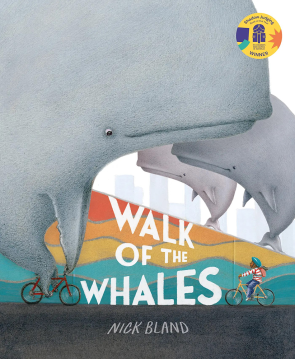
Show students Walk of the Whales by Nick Bland. Read the title and discuss the images on the front and back covers. Ask students to share their thoughts about the title:
- Does it surprise them? Consider that the whales are walking on land – unusual behaviour for sea animals!
- Why do they think Bland chose that title?
- What clues does the title provide to help students make a prediction about what could happen in the story?
Before reading the blurb, ask thought-provoking questions such as:
- Where do whales live?
- Why might an animal leave its home?
Finally, read the blurb on the back cover. Afterwards, ask:
Why do you think the whales left the ocean and walked into the cities and towns?
Have students record the vocabulary, image clues, and prior knowledge they used to make their prediction on the story prediction worksheet (PDF 01, 49KB). Record and revisit the predictions after reading the story.
During reading
NOTE: For the purpose of tracking page numbers, the first page of the story will be considered p. 1.
Think-alouds
To support students’ inferencing skills, demonstrate thinking aloud as you read Walk of the Whales to the class. Focus on sections of the text that you think students will find challenging. Encourage them to look closely at the visuals as you read. You can ask a selection of thought-provoking questions, but do not stop to answer them – try to maintain the flow and enjoyment of the initial read.
Possible discussion points include:
- I wonder why some people frowned when the whales walked out of the ocean (p. 3)?
- What is the whale doing to upset the people using the swimming pool (pp. 5–6)?
- Where is the music coming from on the trains (p. 9)?
- Where have all the rubbish and cracks come from (pp. 13–14)?
Invite students to record any new words that they do not understand while listening to the story.
Now read Walk of the Whales again, this time pausing and engaging students in discussion. Encourage them to actively listen to one another and extend their own ideas to find connections within the text.
Exploring the text in context of our community, school, and ‘me’
After reading
Unfamiliar vocabulary
Students can turn and talk with an elbow buddy to discuss the unfamiliar words from the story. Their partner may be able to explain some of them. This pair will then find another pair and repeat the discussion before reporting back to the whole class.
Record the new words on a word wall for future reference. Encourage students to explain how they worked out the meaning of unfamiliar words in the text. Then model how they might be able to work out the meaning of a word using context clues or morphemic knowledge (i.e. the smaller words that make up bigger words, e.g. graceful = grace + ful), as well as knowledge of prefixes and suffixes.
Words that may be discussed include:
| Greeted | Delighted | Slightly | Graceful | Awfully | Fondness |
| Plankton | Anti- (Prefix) | Balcony | Gigantic | Ashore | Evermore |
You might like to explore the prefix ‘anti-’ and the suffixes ‘-ed’, ‘-ly’, ‘-ful’, and ‘-ness’ in more detail.
(AC9E2LY02) (AC9E2LY05) (AC9E2LY12)
Rich assessment task
Discuss what students liked or did not like about Walk of the Whales. This may include the characters, setting, and events. Ask students to explain their opinions with reference to the text. They can also make connections to other texts and familiar experiences.
Students should record their response and draw an accompanying image. You can scaffold this task by providing some sentence starters:
- I feel/believe …
- In my opinion …
- This reminds me of …
- I liked/did not like it when …
- The words and pictures made me feel … about [character/setting/event], and for this reason I liked/did not like the story.
As you explore other texts throughout the year, it would be beneficial to have informal discussions as a class, modelling appreciation and providing justification.
Responding to the text
Making connections
Tell students that good readers make connections with what they are reading. This helps to activate prior knowledge and build understanding of the text. If students are not already aware, explain the three types of connections. Use a familiar text to model each type (text-to-text, text-to-self, text-to-world) and provide scaffolding so that students can share their own connections to the same text. They can then share any connections they made to Walk of the Whales verbally or using the connections table (PDF 02, 43KB).
Reassure students that they do not have to make all three connections to a text.
Exploring plot, character, setting, and theme
Theme
Clarify what a theme is in a text (i.e. the overall message, lesson, or moral). Explain that stories can have more than one theme and that students will have to use their inferencing skills to identify them. Provide examples of themes from stories you have explored in class. Invite students to suggest others.
Discuss how to identify the theme in a story. The following questions may be useful:
- What changed from start to finish?
- How did the characters change/develop in the story?
- What are the consequences of the actions in the story?
- What was the complication and how was it resolved?
- How can I connect to the story?
- How does the story make me feel?
- What message is the author trying to tell me?
Use familiar texts to model this process. Jointly identify the theme(s) in each story and justify the answers using evidence from the text.
Ask students what they think the theme of Walk of the Whales might be. Prompt them to give reasons/evidence for their answers. They might suggest:
- The importance of looking after the environment
- Working together to achieve goals
- Asking questions and listening to better understand each other
Record students’ ideas on the theme worksheet (PDF 03, 48KB).
Now watch the short film ‘A Whale’s Tale’ and compare the themes to those in Walk of the Whales. Are they the same or different? Why?
NOTE: The theme and main idea are not the same thing. For this reason, they should initially be taught separately.
Rhyme
Ask students why authors include rhyme in their texts (e.g. to entertain, to help with memory, to make words stand out). Point out that rhyme is often a feature of picture books. Ask students where else they may have heard rhyme; they may suggest poems, nursery rhymes, chants, advertising, or songs.
Identify the rhyming pairs in Walk of the Whales, then guide the discussion towards songs. Discuss the fact that most song lyrics rhyme. Invite students to name some songs that they know. You could play a few age-appropriate examples or examine the lyrics together to look for the rhyme.
Tell students that whales are also known to sing. They make a variety of sounds (like the ones in this video) to communicate underwater. Draw students’ attention to p. 9, which shows a whale singing on a train. Ask students if they think the boy likes the whale’s song and how they know this (inferencing required). Then ask what the whale might be singing about. This could be related to the themes of the story. Brainstorm some ideas and try to come up with some related rhyming pairs. For example:
Missing home:
|
The ocean:
|
Tell students that they are going to create a rhyming song. Start by modelling or jointly writing the first four lines. These should incorporate two rhyming pairs from the class brainstorm. Students can then break into small groups to write another four lines (or more, if they feel inspired). Once they have practised in groups, they will independently write a rhyming song (consisting of at least eight lines) from another whale’s perspective in Walk of the Whales. Students should practice reciting their songs (or singing them, if they feel comfortable) before presenting them to the class or recording them on a device.
Inferencing and images
Explain that authors and illustrators sometimes provide information/meaning that can be found ‘right there’ in the text or images. This is literal information. Provide an example from Walk of the Whales (e.g. the delighted fish seller on p. 4).
Sometimes the information or meaning is not ‘right there’, but the author or illustrator will leave clues, and the reader needs to use their prior knowledge to make an inference. Provide an example from the text, such as pp. 13–14. To understand why the footpaths cracked, students need to make the connection between a whale’s size and weight and the fact that even something as hard as concrete has a weight limit!
Tell students that Nick Bland leaves many clues in the text and images rather than presenting information ‘right there’. Choose a double-page spread to re-read, stopping to consider that the text would not make sense without the image, but when they are combined (along with prior knowledge) the reader can understand what is happening.
In small groups – ideally with copies of the text – students will look for examples of how Bland’s illustrations add meaning to the words in the story. Encourage students to focus on plot rather than characterisation, as this will be explored in the Examining section. Model and jointly construct responses using the images and inferencing worksheet (PDF 04, 48KB).
Rich assessment task
Display an illustration from Walk of the Whales that the class has not yet explored together (some examples have been provided below). Invite students to independently complete the images and inferencing worksheet to explain what they inferred from the image and how.
You might like to use the following probing questions for this assessment (as well as the previous activity):
- How does the image help the reader understand:
- Why some people greeted the whales with frowns (p. 3)?
- Why the lady is pumping up tyres a lot (p. 7)?
- Why the ballet is less graceful, but the dancers are strong (p. 9)?
- How the birds ruined the statues (pp. 19–20)?
Examining text structure and organisation
Summarise the sequence of events
Discuss/revise the structure of a narrative (orientation, complication, resolution, coda) and the features of each part. Display a familiar graphic organiser (e.g. a story graph or storyboard) that shows the key events in a story.
Explain what a summary is and model a verbal summary of the main events of a familiar story (this might be one you have read in class). Use sentence starters such as:
- The story introduces …
- The complication occurs when …
- Finally, the problem is resolved when …
- In the coda, the characters …
In groups, students will arrange the main events in Walk of the Whales in order under the correct narrative headings (orientation, complication, resolution, coda). You could print the headings and events on strips of paper for easier sequencing. Alternatively, you could prepare a drop-and-drag activity using a tool like Google Slides. Students could then sort the events on their devices.
Students will then take turns using the above sentence starters to verbally summarise Walk of the Whales for a partner. This could be recorded, with students evaluating their own summary and/or providing feedback for peers.
Examining grammar and vocabulary
Conjunctions
In Year 1, students learned that a simple sentence is made up of a single independent clause representing a single event or idea. Focus on the sentences below, asking students to identify the words that tell us about the ‘happening’ or ‘state’ (verb/verb group), the ‘person’ or ‘thing’ (noun/noun group), and details about ‘when, where, and how’ (adverb or prepositional phrase). There is an international colour pattern for this sort of grammar analysis:
- verbs are green
- nouns are red
- adverbs/prepositional phrases are blue
NOTE: Always start with a question about the ‘happening’ or ‘state’, as verbs are the heart of a clause. Once the verb/verb group has been identified, ask other appropriate questions to guide students towards identifying the noun(s), adverb(s), or prepositional phrase(s).
‘The man selling fish was delighted.’ (p. 4)
| Question | Answer |
| What are the words that tell us what is happening? | ‘was delighted’ (verb group) |
| What are the words that tell us about the person who was delighted? | ‘The man selling fish’ (noun group) |
‘She leaned out from her balcony.’ (p. 23)
| Question | Answer |
| What are the words that tell us what is happening? | ‘leaned out’ (verb group) |
| What is the word that tells us about the person who leaned out? | ‘She’ (noun) |
| What are the words that tell us about where she leaned out? | ‘from her balcony’ (prepositional phrase) |
In Year 2, the focus is on compound sentences containing two or more independent clauses, usually linked by a coordinating conjunction. Focus on the sentences below, once again asking students to identify the words that tell us about the ‘happening’ or ‘state’, the ‘person’ or ‘thing’, and details about ‘when, where, and how’.
NOTE: If there is more than one ‘happening’ or ‘state’ (verb/verb group), then there is more than one clause. Use ‘//’ to indicate a clause break. Once the verb/verb group has been identified, guide students towards identifying the noun(s), adverb(s), or prepositional phrase(s) for each clause, and then the conjunction that joins the two independent clauses.
‘All of the restaurants ran out of fish, and their customers couldn’t relax.’ (p. 16)
| Question | Answer |
| What are the words that tell us what is happening? | ‘ran out of’ (verb group) and ‘couldn’t relax’ (verb group) |
| Where is the clause boundary? | After ‘fish’ |
| What are the words in the first clause that tell us about the thing that ran out? | ‘All of the restaurants’ (noun group) |
| What is the word in the first clause that tells us what all the restaurants ran out of? | ‘fish’ (noun) |
| What are the words in the second clause that tell us about who couldn’t relax? | ‘their customers’ (noun group) |
| Does the first clause make sense on its own? | Yes, it’s an independent clause |
| Does the second clause make sense on its own? | Yes, it’s an independent clause |
| What is the word that joins the two independent clauses? | ‘and’ |
| What do we call the word that joins the two independent clauses? | A conjunction |
| Why did Nick Bland use the ‘and’ conjunction to join the clauses? | To bring the meanings of the first and second clauses closer together |
‘The shopkeepers went out of business and the bakers could not make the bread.’ (p. 17)
| Question | Answer |
| What are the words that tell us what is happening? | ‘went out of’ (verb group) and ‘could not make’ (verb group) |
| Where is the clause boundary? | After ‘business’ |
| What are the words in the first clause that tell us about the thing that went out? | ‘The shopkeepers’ (noun group) |
| What is the word in the first clause that tells us what the shopkeepers went out of? | ‘business’ (noun) |
| What are the words in the second clause that tell us about who could not make? | ‘the bakers’ (noun group) |
| What are the words in the second clause that tell us what the bakers could not make? | ‘the bread’ (noun group) |
| Does the first clause make sense on its own? | Yes, it’s an independent clause |
| Does the second clause make sense on its own? | Yes, it’s an independent clause |
| What is the word that joins the two independent clauses? | ‘and’ |
| What do we call the word that joins the two independent clauses? | A conjunction |
| Why did Nick Bland use the ‘and’ conjunction to join the clauses? | To bring the meanings of the first and second clauses closer together |
Synonyms and antonyms
In Walk of the Whales, people have different opinions about the whales. For this reason, Bland uses words that have opposite meanings. Explain that these are called antonyms. Provide some examples before locating others in the text (e.g. smiles / frowns, ups / downs).
NOTE: You might like to explore the literal and inferential meaning of ‘up’ and ‘down’.
The text reveals that the swimming pool users were not delighted (p. 6). Jointly decide on an antonym for ‘delighted’ (the context and image will be useful). Students might suggest ‘unhappy’, ‘sad’, ‘upset’, and so on.
Now explain what synonyms are (words with the same or similar meaning). An author may use synonyms to reinforce a character’s qualities and keep the vocabulary interesting.
Focus on the word ‘tired’ (p. 13) and discuss what this means. Make a list of synonyms for ‘tired’ as it is used in this part of the story. Students might suggest ‘bored’, ‘frustrated’, ‘annoyed’, and so on.
Now explore synonyms and antonyms for the following words from the text (in groups or as a whole class):
| Overcrowded | Beautiful | Strong | Graceful |
| Relax | Ruined | Shouting | Gigantic |
In preparation for exploring character traits, provide examples of adjectives that can be used to describe characters. Have students match antonym pairs and then list more interesting synonyms. The character trait cards (PDF 05, 48KB) will support this lesson. You can use them in a variety of ways:
- Provide pairs or small groups with the whole set of cards and ask them to match the antonym pairs before writing synonyms for each word.
- Match the antonyms as a whole class, then give each pair or group of students a set of antonyms for which to write corresponding synonyms.
You might like to display lists of synonyms and antonyms for students to refer to (Hubble Star or YourDictionary may assist with this).
Character traits
Revisit character traits before providing a few examples and asking students to suggest others. Ask them to think about how authors and illustrators communicate what a character is like or how they want readers to feel about a character. Invite students to think-pair-share. Then explain that carefully chosen vocabulary and images help develop a character’s personality.
Examine some words and images that demonstrate a character’s traits from a familiar text. Ask what vocabulary the author uses to build the character (nouns, verbs, adjectives), and how the illustrator shows their qualities (colour, size, position, facial expression, body language, actions, etc.).
For example, in The Patchwork Bike* by Maxine Beneba Clarke, the main character introduces their family on pp. 3–6. The images show the brothers jumping on a car and the mum frowning and pointing, as if telling the boys to get down. There is literal information about the brothers’ traits – ‘crazy’ (adjective) – but not the mum’s. If students were to infer her qualities, they might say that she is strict or serious or caring (depending on how you look at it). The word ‘fed-up’ (adjective) tells us that she is annoyed; it seems that she constantly has to keep an eye on the boys’ behaviour. Looking at the image, her facial expression and body language show that she is unhappy. Her posture and size on the page make her look strong.
* Reading Australia title
Authors can communicate character traits by showing rather than telling. You might like to revisit the Responding section and review the difference between literal and inferential information (under Inferencing and Images). Then, as a class, identify Frida’s character traits as they might be seen by the whales in Walk of the Whales. Use think-alouds to assist with this. For example, on p. 22:
The words are telling me that Frida ‘yelled’ – this is a saying verb. She also tells the crowd that they have the ‘wrong idea’ – ‘wrong’ is an adjective. I can see in the picture that Frida has a megaphone and she is using it to yell at the crowd protesting below her. If I were the whales, I would think that Frida is confident and brave because it can be scary to speak loudly in front of lots of people, especially if you are telling them that they are wrong.
The next page (p. 23) offers more vocabulary and additional traits for Frida – students might suggest that she is passionate, caring, thoughtful, curious, or a problem solver. Use their responses to complete the inferred character traits worksheet (PDF 06, 50KB).
Advise students that characters may have different opinions from one another. It would be interesting to repeat this activity and infer Frida’s traits as they might be seen by the townspeople.
Finish by jointly constructing the qualities of the townspeople as a collective/group from the whales’ perspective. Focus on the townspeople who are opposed to the whales. Use the worksheet to record students’ responses.
(AC9E2LA07) (AC9E2LE01) (AC9E2LY03)
Rich assessment task
Working individually, students can identify the whales’ character traits as they might be seen by the townspeople who are opposed to their presence. They should fill out the associated worksheet and draw a picture of the whales to accompany their work.
Perspectives: for and against
Discuss the meaning of perspective and the idea that people can have different or alternative perspectives. Identify the different characters in Walk of the Whales (excluding the whales). As a class, list the reasons why these characters were for or against the whales. Record the responses in a table like the one below. Ask students which side they agree with and why.
| For | Against |
|
|
NOTE: It would be interesting to discuss why students think the children smile at the whales (p. 2), as this could be another reason in the ‘for’ column.
Ask students to imagine that the townspeople from Walk of the Whales are holding a town meeting. They will role-play as different characters and express their opinions about the whales. Consider allocating the roles to ensure that different perspectives are represented. Provide a basic script and allow time for students to practise what they will say. For example:
Hello, I am [name] and I am the [occupation/role] in our town. I am [feeling] about [what is making them feel this way], so I want the whales to [leave / stay].
The for/against table will support students to express their characters’ opinions. They are free to make changes to the script and add their own details, if desired.
Instruct students to enter the classroom as if it is the town hall. They should move around and mingle with one another, offering their opinions in character as practised. This will allow less confident students to participate within a larger group rather than on their own in front of the whole class. After some mingling time, call the town meeting to order and invite students to stand up and offer their perspective for or against the whales.
If your students require additional scaffolding, invite them to move around the room while you play music. When the music stops they will face the nearest partner and wait for you to ask a question (e.g. how do you feel about the whales in our town? How have you been impacted by the whales?). Students will then take turns to answer the question in character. Repeat this process several times with new questions.
Tell students that they are going to write an alternate version of Walk of the Whales that tells the story from a specific character’s perspective. Begin by discussing whose perspective Walk of the Whales is written from. Guide students to see that all perspectives are represented at some point in the story.
Jointly brainstorm and plan how to tell the story from another perspective (e.g. Frida’s). Construct the text as a whole-class exercise. It is not necessary for the story to rhyme.
Rich assessment task
Students will independently write an alternate version of Walk of the Whales from a different character’s perspective (e.g. the fishmonger, a swimmer at the pool, a child in the town, a restaurant owner). As above, they should start with a brainstorm and plan before writing their first draft.
Encourage students to make vocabulary choices that reflect their chosen character’s perspective on the whales. They should do their best to:
- Follow a narrative structure (orientation, complication, resolution, coda)
- Include some interesting synonyms
- Communicate their character’s traits by showing rather than telling
Ask students to identify these elements in their draft or make a note of where they could be added. Once they have edited and proofread their work, they can write the final version.
Remind students to give their story a title. If time allows, they could design a cover or illustrate a scene to accompany the text.