Connecting to prior knowledge
Before reading The Eleventh Hour by Graeme Base for the first time, conduct a book orientation with the students. Discuss birthdays and other kinds of parties:
- What do students like about these events?
- What kinds of preparations do families make to celebrate?
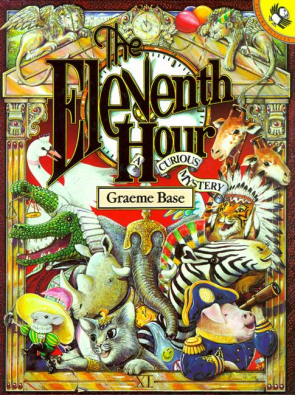
Ask the students what clues about the text they can see by only looking at the cover. As this is bright, colourful and full of detail, displaying an enlarged copy from the publisher’s website will assist all children to view it clearly. Questions about the cover to prompt the students in their thinking may include:
- What animals can you see on the cover?
- Why do you think the animals are wearing costumes?
- What is unusual about the pictures on the cover?
Continuing with the orientation, flick through the book and point out selected pages, and stop to look at tricky words. Take the opportunity to talk about key vocabulary from the text, focusing on the language used to describe the party. Ask the students if they have ever received an invitation (p. 2). Discuss what a ‘grand affair’ (p. 3) might be. Encourage the class to discuss what the description makes them think of, and consider synonyms that we might use.
Finally, ask the class to make predictions about what might happen in the book based on the first look at the images. Note these on the whiteboard or butcher’s paper for discussion after the first reading.
Exploring the text in context of our community, school and ‘me’
After the first reading of the text, encourage the students to share what it is that they found interesting about the book. Write all the answers on the whiteboard or butcher’s paper to refer to later.
As a class, jointly construct a text analysis chart to explore connections between The Eleventh Hour and the students’ own prior experiences. This activity is designed to draw students’ attention to the imagery in The Eleventh Hour and is adapted from Feldman’s Critical Process Model.
Before creating the whole class chart described below, draw the students’ attention to the variety of semiotic systems used within the text:
| Linguistic | The use of text features |
| Visual | The colours and effects in the illustrations |
| Spatial | The arrangement of the images on the page |
Write the following questions on a large sheet of butcher’s paper divided into four sections (as below). Students should consider these questions in pairs.
| DESCRIPTION: What can you see in the pictures?
|
ANALYSIS: How does the picture make you feel?
|
| INTERPRETATION: Have any parties that you have been to looked like this?
|
JUDGEMENT: What else would you like to be included in the pictures?
|
After brainstorming each of these questions, create a list of what works best in the pictures displayed in The Eleventh Hour. This will be useful for students to refer back to when they are completing their Rich Assessment Task.
(AC9E1LA02) (AC9E1LE01) (AC9E1LY02)
Rich assessment task
To continue with an introduction to the visual aspects of The Eleventh Hour, ask students to describe an invitation that they might create for a ‘grand affair’. In small groups, students plan their grand affair by thinking about what to write on their invitation, what illustrations or images might be used and what colours will be prominent. Each group could create a collage that shows what their illustration might look like. These plans can be shared, discussed and reflected upon.
Responding to the text
When exploring The Eleventh Hour for the second time, read through the text completely with the whole class. After reading, ask the students:
- What could help us solve the mystery of who stole the feast?
- Has the author provided some clues in the illustrations?
- Are there clues in the illustrations that are different to those in the text?
Provide small groups of students with copies of the book, open at the double-page spreads before AND after the banquet pages. Encourage students to discuss the similarities and differences that they notice on each of these pages. Regrouping as a whole class, discuss the additional clues that Graeme Base has provided in the borders around each page. Allow students to see if they can find the message in the outside border (‘Can you find a hidden message in every illustration?’). The letter charts on the walls also provide clues to discuss (‘Do not guess’ and ‘Now you see it’). Encourage students to think about what this might be referring to. Further explanation around these clues can be found in the ‘Top Secret’ section at the end of the book.
Students then turn and talk with a partner. Discussion questions about the illustrations may include:
- Why has the author included a message in the border?
- Does the message that is written in the border relate to the story?
Exploring plot, character, setting and theme
Students will investigate the mystery in The Eleventh Hour by breaking into viewers’ circles. This technique allows for student-led discussion, negotiation, decision-making and problem-solving. Each group of students will appoint a discussion manager to oversee their circle. Modelling the roles and routines involved will be essential so that the children can go on to identify key aspects of the text independently.
Allocate each circle a double-page spread to try and locate clues to the mystery. They should note these clues on mini whiteboards or a large sheet of paper. After each circle has crafted a list of possible clues, they will share with the whole class. A master list can be jointly constructed on the whiteboard. These clues will be useful for the next Rich Assessment Task by providing students with a list of possible suspects.
(AC9E1LA02) (AC9E1LY04) (AC9E1LY05)
Rich assessment task
As a concluding activity, encourage the students to discuss how and why we make decisions. Guide students to consider how each of the decisions that we make can be because of the way we felt at a particular time.
These topics are designed to get students thinking about what the culprit’s motivations might have been for stealing the feast. Ask students to think about which character might have had the most to gain from this. They can develop a list of possibilities together and come up with some questions for a hot seating activity to help them refine their theories.
Ask students to decide which character they think is most likely to have stolen the feast. This could be the actual thief, or another character.
Ask students to write a short letter to Horace from the character that stole the feast, explaining the reasons for their decision. The previous list of theories may assist students with the vocabulary needed to construct their letter. Students can share their response with a partner, small group, or the whole class.
Examining text structure and organisation
Before re-reading the text with the whole class, discuss some of the tools that Graeme Base has used throughout the book to give the reader clues as to what is happening in the story. Students may suggest that clues are found in the text itself, in the colour and style of illustrations, and that sometimes hidden clues are included. When sharing the text with the class, ask students to keep an eye out for any clues that tell us what time of day it is as the story progresses.
Put students in small groups, each with a copy of the text. Ask students to see what different types of clocks they can find. As a whole class, share where these clocks were and discuss what times they display. Write all of the times onto a large sheet of butcher’s paper. As a class, brainstorm a short sentence that outlines what happened at each time, for example:
- At 08:00 am, Horace wrote a list of friends to invite to his party.
- At 04:30 pm, Horace started cooking the feast.
After brainstorming a class list, students could work in small groups to create their own timeline of events for a party, a special event, what they did on the weekend, or what they have done that day.
Examining grammar and vocabulary
To develop vocabulary skills for describing and comparing, model how to compare and contrast images. Using two sets of pictures – a page from the text and a real life shot of animals – model how to compare and contrast features. For example, you might pick the double-page spread of Horace and his friends playing tennis, and present this with pictures of an elephant, a tiger, a swan and a crocodile.
Possible questions to students may include:
- Which image do you prefer?
- What differences do you notice between the real life pictures and those created by the author-illustrator?
- Why did the author-illustrator draw the animals in this way?
To further develop the students’ understanding of vocabulary structures in The Eleventh Hour, guide students to discuss the different text structures Base uses to convey messages. Discussion questions could focus on the rich word pictures that are created and the rhyming nature of the text. For example:
The Mouse came as a Musketeer, his head and hat held high,
A swagger in his footsteps and a twinkle in his eye.
And one by one the chairs became just piles of splintered wood,
(The Guests were all agreed that this new game was jolly good!)
Then as the final chair collapsed they stopped and checked the score;
And since no one had won at all, they settled on a draw.
A concluding discussion could be centered around how students may use pictures to enhance the messages they present in their own writing. Further discussions may include creating a list of features that authors and illustrators use to add emphasis to their writing. Exploration of Base’s other works such as Uno’s Garden and Animalia could assist in the construction of this list.
Rich assessment task
Ask the students to share what it is that they have had to do in order to understand all of the information that the text had to share. Possible answers may include:
- reading the text
- looking at the images
- seeing what clues were present in the colours and illustrations
- looking closely at the borders of each page
- reading the top secret information at the end of the book
Following this discussion, ask students to create a ‘code-cracking’ sheet that a reader could use to figure out who stole the feast. This activity would be great for a buddy class, as the older students could assist their buddies to access the top secret information in the back of the book. Students could create a code-cracking sheet for just one page of the text and put this together as a whole class code-cracking manual.
Puppet reader’s theatre
After re-reading The Eleventh Hour, students will choose a character to create a simple finger puppet. Pictures of real animals could be used as the basis for the puppets, to link to the compare and contrast activity from the Examining section. After the puppets have been created, ask students to consider:
- What characteristics does their puppet have?
- What is the personality of the character depicted like?
- What does the character sound like when they speak?
- Is the character’s voice loud or soft?
- Does the character speak fast or slow?
After practising their puppet’s voices and personalities, students can work in small groups to script, rehearse and perform a reader’s theatre with parts of the book over several sessions. The script could be rehearsed and recorded so that the children can listen and reflect on it and re-record if needed. When the puppet performance occurs, the children could play the recording so that they can focus on their puppets. One member of the group can record the performance on an iPad, so the performance can be watched afterwards.
Creating character descriptions in the style of Animalia
For this activity, read Animalia by Graeme Base to the class (if you cannot find a copy, you can watch this read-aloud by Captain Starlight). After the first reading, ask students to identify the similarities between this book and The Eleventh Hour. Jointly create a list of similarities, highlighting the use of language, vocabulary and illustrations.
Now ask students to brainstorm all of the characters in The Eleventh Hour. Select one of the characters and create a whole class character description in the style of Animalia, using descriptive words that begin with the same letter as the character’s name. Using the interactive writing technique, model the brainstorming, drafting and revising stages of the writing process. In the revising stage, encourage students to think of different types of describing words that are more complex.
(AC9E1LE02) (AC9E1LY03) (AC9E1LY06)
Text innovation
In preparation for this activity, cover the text on each page with a piece of paper or a sticky note. Encourage children to tell the story through the illustrations only. As a class, select the sack race page to jointly construct two sentences that describe what is happening. Model a number of different sentences: some that simply describe, some that rhyme in a similar way to the story, and some that include direct speech from the characters. Links could be made here to the clocks as discussed in the Examining section. Students could suggest how else the author could have portrayed the passage of time in the story. They could then incorporate these suggestions into their own writing.
In pairs, students select a page from The Eleventh Hour and cover the text. They will then draft and create two sentences to describe what is happening in the illustration in a narrative style.
The completed text could then be assembled into a timeline of events as they happen in the story.
Rich assessment task
As a concluding activity to their study of The Eleventh Hour, students will use their finger puppets to craft their own interpretation of the book, or what might happen after the book is finished.
In small groups, students decide which character they will portray. Each group can decide whether to act out the original scene in the illustration, perform their own interpretation of the story, or act out what happens next. In order to support students to feel comfortable presenting their puppet play, they could perform initially in front of one other small group before being given the opportunity to perform for the whole class. As in the earlier activity, the performance could be recorded on an iPad to allow students to watch afterwards.