Connecting to prior knowledge
Australia’s Wild Weird Wonderful Weather, written by Stephanie Owen Reeder and illustrated by Tania McCartney, is an informational text about Australia’s weather (and so much more). Familiarise yourself with the layout of the book before introducing it to students. This is a multimodal text that uses words, visuals, and framing to draw the reader in, and there are several ways you can use it to investigate informational texts.
If you have a document camera or visualiser, you can use it to enlarge specific pages from the book. Having multiple copies in your class library, however, will make it easier to use the book to its full potential.
Tuning in to informational texts
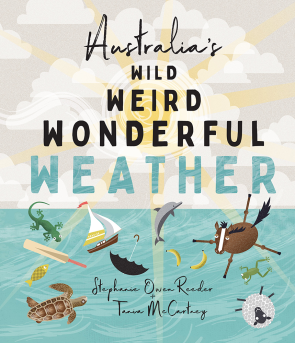
Introduce Australia’s Wild Weird Wonderful Weather by displaying the front cover. There are different ways to tune students in to this text depending on how you want to use it. The following questions may provide a starting point:
- What sort of book do you think this is? Why do you think that?
- What informational text knowledge would a reader need to understand this book?
- Its primary purpose is to inform the reader about the natural world
- It uses general nouns, timeless verbs, and technical language
- What effects might an informational text have on a reader?
Australia’s Wild Weird Wonderful Weather uses multimodal features to convey meaning. It is important that students have some understanding of the conventions of informational texts so that they can see the differences between this and other texts they have read. Notable features include:
| Table of contents | Chapters or sections | Headings and subheadings | Glossary |
| Index | List of resources | Maps | Illustrations |
| Diagrams | Photographs | Tables | Graphs |
(AC9E4LA03) (AC9E4LE02) (AC9E4LY03)
Pre-assessment
Distribute and have students complete the features table (PDF, 54KB). Then ask:
- Where do we find these features in an informational text?
- What is the function of each of these features?
This pre-assessment will help you gauge students’ understanding of informational texts at the beginning of the unit. You could repeat the exercise at the end of the unit to see if there has been growth in their understanding of these terms.
(AC9E4LA03) (AC9E4LE02) (AC9E4LY03)
Tuning in to the focus text
Ask students:
What do you know about Australia’s weather?
Students can record their thinking on sticky notes and put these on an anchor chart under the heading ‘What we think we know about Australia’s weather’. You could also do this digitally using Padlet or another collaborative platform. Make sure all students can see the responses.
Other headings for the anchor chart include:
- What we have confirmed we know about Australia’s weather
- New information about Australia’s weather
- Questions/wonderings we have about Australia’s weather
- Misconceptions we had about Australia’s weather
These headings are informed by the work of Linda Hoyt and Anthony Stead. As the unit progresses, move the sticky notes from ‘what we think we know’ to either ‘what we have confirmed’ or ‘misconceptions we had’. Record new information and any questions/wonderings under the relevant headings as they emerge; when you find the answer to a question/wondering, record that too.
Refer to this anchor chart throughout the unit. Any sticky notes remaining under ‘what we think we know’ represents thinking that has neither been confirmed nor proven to be a misconception, and so may require further investigation.
Whole class discussion
Ask students:
Thinking about what we have discussed so far, what would you expect to find in a book about Australia’s weather?
Record the responses on a second anchor chart or in another shared document. Encourage students to give reasons for their thinking by asking, ‘What makes you say that?’
Display the front cover of Australia’s Wild Weird Wonderful Weather once again, then display and read the blurb on the back cover. Ask students:
- What do you notice?
- What wonderings do you have about this book?
- Would you describe this as a complex text?
- Would you describe this as a technical text?
- Why would an author produce this text?
- Who is the audience for this text?
Record students’ thinking. They may notice that:
- There is alliteration in the title, and assume that the text might be interesting and fun
- The images on the cover are comical rather than technical
- The descriptors in the title (‘wild’, ‘weird’, ‘wonderful)’ are non-technical words
Ask students what would happen if they removed some of the descriptors from the title. For example, if the book was just called Australia’s Wild Weather or Australia’s Wonderful Weather, what would they see as the purpose of the text?
Exploring the text in context of our community, school, and ‘me’
Before looking at the chapter headings and subheadings in Australia’s Wild Weird Wonderful Weather, it would be useful to complete a pre-vocabulary task. With the exception of ‘precipitation’, the words on the Contents page do not appear in the glossary (see Weather Words, pp. 60–61). The chapter headings and subheadings contain a mixture of tier one, two, and three words:
| Weather | Bush | Forecasting | Precipitation | Cloud | Rain | Wind |
| Rogue | Extreme | Weatherproofing | Antics | Nature | Future |
Distribute the meaning match worksheet (PDF, 80KB) and invite students to complete it in pairs or groups of threes. When they have finished, regroup as a class to compare and discuss the responses.
Now divide the class into seven groups and assign each group a chapter from the book. Distribute the subheadings worksheet (PDF, 53KB) and ask the groups to identify which subheadings belong to their assigned chapter. In doing so, they might also work out which subheadings belong to the other groups/chapters.
The purpose of this task is to get students looking at the Contents page and noticing the chapter headings and subheadings. They can then start thinking about the content of Australia’s Wild Weird Wonderful Weather and how it might be different to other informational texts.
Afterwards, invite each group to share their choices. If they did not pick the subheadings that matched their assigned chapter, redirect with focused questioning and discussion.
Display the Contents page so that everyone can see it (use a document camera or visualiser if one is available to you). Some of the subheadings are straightforward while others are more obscure (e.g. ‘Animal Antics’, ‘Blow, Wind, Blow!’). Draw attention to these and ask students to predict their connection to the respective chapters. This may be challenging! Discuss why the author may have included some obscure subheadings in an informational text.
Students can then return to their groups and discuss what they think their assigned chapters will be about. Invite them to share their ideas in a whole class discussion.
(AC9E4LA11) (AC9E4LE02) (AC9E4LY03)
Rich assessment task
Have students work in pairs or groups of three to discuss the visual design of the front and back covers. Discuss the effect of framing, salience, and the positioning of elements (the Visual Literacy website may assist with this). Possible discussion points include:
| Front cover |
|
| Back cover |
|
After looking at the front and back covers, the Contents page, and the different chapter headings and subheadings, students will individually design a title page for a chapter from Australia’s Wild Weird Wonderful Weather. Allocate the chapters to ensure even distribution across the class.
The title page should be portrait orientation, incorporating the chapter heading and the use of visuals and colour. It must reflect the content of the allocated chapter (e.g. ‘Disastrous Weather’ covers natural disasters, record-breaking weather, and weatherproofing) and differ from the existing title page in the book.
Students may choose to work digitally or on paper as desired. They can refer to the front and back covers, as well as any classwork and discussions from the unit so far, for inspiration. Invite them to present their finished title pages to the class and explain their choices regarding the use of colours and visuals and the placement of words and other elements.
Responding to the text
Monitoring weather
Tell students that they will be monitoring the weather in their local area and state over the course of the unit. This will involve keeping notes in their workbooks or on a device. The notes can include photos (taken or sourced), audio recordings, sketches, and diagrams, and can be as detailed as students wish. Regularly ask them to share their notes as the unit progresses. Display relevant news reports when you notice weather events in your area/state such as cold temperatures, gale-force winds, high precipitation, etc. Also start a word wall and invite students to add interesting weather-related vocabulary.
If you have not already done so, discuss isobars and high and low pressure systems. These are seen on p. 38 of Australia’s Wild Weird Wonderful Weather (opposite the ‘Weather Forecasting’ title page) and explained on p. 45.
Researching weather
The title page for each chapter in Australia’s Wild Weird Wonderful Weather features a quote from a historical gazette or newspaper article. Stephanie Owen Reeder lists these articles and explains how to access them on p. 63 (under ‘Researching Weather’ > ‘Weather Resources’). She specifically credits the National Library of Australia and their free online research portal, Trove. Follow Reeder’s instructions or use the links below to locate the articles yourself:
| 1. Seasonal Weather | The Gnowangerup Star and Tambellup-Ongerup Gazette, 1940 |
| 2. Precipitation | The Yass Courier, 1910 |
| 3. Sound, Light, Movement | The Daily Mercury (Mackay), 1953 |
| 4. Disastrous Weather | Jim McJannett, Torres News (Thursday Island), 2008 |
| 5. Weather Forecasting | ‘Cub Reporter’ Betty Wilson, aged 9, The Age (Melbourne), 1937 |
| 6. Climate Change | The Courier-Mail (Brisbane), 1950 |
| 7. Researching Weather | Daily Commercial News and Shipping List (Sydney), 1938 |
Re-form the groups from the subheading activity (see Literature > Exploring the Text in Context of Our Community, School, and ‘Me’) and have them read the article that relates to their assigned chapter. Each group should orally summarise their article and share the key points with the rest of the class.
Display the articles in chronological order and discuss how the appearance of news items has changed over time. Identify the salient characteristics and explore how available technologies have impacted presentation.
Another useful source for learning about the weather is the Bureau of Meteorology (BOM). Students can read sections of Australia’s Wild Weird Wonderful Weather and consult the BOM website for more information. It contains some interesting articles with good diagrams and visuals. For example, this 2020 blog post complements the ‘Shiver Me Timbers!’ section on pp. 20–21. The book does not specifically mention avalanches, but the BOM explainer on this topic is worth exploring.
Consolidating and connecting
As students continue their research, they should note any new vocabulary and add it to the class word wall. Use the newly discovered words to investigate word origins and spelling patterns, including (but not limited to) double letters, morphemes (smaller base words and word families), prefixes, and suffixes.
Students will need to dip in and out of Australia’s Wild Weird Wonderful Weather and use the information therein to make text-to-self, text-to-text, and text-to-world connections. The book prompts curiosity and students should feel free to ask and record their questions/wonderings and make connections as they read. Whether you are unpacking the book as a whole class or in smaller groups, encourage students to turn and talk with a partner to discuss their thinking. Record any questions/wonderings as the unit progresses and regularly revisit the anchor chart from the Literature section (under Connecting to Prior Knowledge > Tuning in to the Focus Text) to note the questions that have been answered and those that require further research.
Rich assessment task
Explain to students that they are going to deepen their understanding of the gazette/newspaper article they explored earlier (under Researching Weather). Working in the same groups as before, they will use PowerPoint or similar to create a slideshow that:
- Presents a summary of the article, including as many of the 5 W and H questions as possible (especially the question of ‘where’)
- Includes relevant visuals, such as photos from the time, scientific diagrams, or original artwork/illustrations
- Considers spatial design to add meaning to the presentation
Each group should be prepared to explain their choices regarding language, visual, and spatial features. They should also note which parts of the article reflect facts, opinions, and feelings and discuss the implications of each in news reporting.
Model how to summarise an article; identify opinions, feelings, and facts; and prepare a slideshow if students are not already familiar with these processes.
Examining text structure and organisation
There are five semiotic systems for conveying meaning in a text. Australia’s Wild Weird Wonderful Weather uses four of them:
| System | What it refers to | Examples |
| 1. Linguistic | Spoken and written words | e.g. vocabulary, grammar, structure |
| 2. Visual | Still and moving images | e.g. colour, salience, framing |
| 3. Spatial | Layout and organisation of objects | e.g. proximity, position, direction |
| 4. Gestural | Facial expression and body language | e.g. body, hands, eyes |
Gather some other non-fiction texts about Australia’s weather, such as Deadly Science Book 2: Wild Weather edited by Corey Tutt. There is a booklist on p. 62 of Australia’s Wild Weird Wonderful Weather, though some of these titles may be too advanced for Year 4 students. Further suggestions can be found under More Resources, including picture books and narrative non-fiction.
Give students time to explore the texts. Working in groups of three, they will select two to compare and contrast. They can record their thinking on a Venn diagram with reference to the semiotic systems listed above. They could also consider the publication date for each text and how this may have influenced its content and/or presentation (e.g. due to available technologies), though you may need to lead them through this part of the discussion.
(AC9E4LA10) (AC9E4LE01) (AC9E4LY01)
Now choose a double-page spread from Australia’s Wild Weird Wonderful Weather to examine as a class. Point out that this is the typical layout across the book. Ask students:
- How do we read these pages?
- Where do you start reading?
- What do you notice on these pages (with reference to the semiotic systems)?
- Is there anything that you recognise from another text, or that reminds you of another text?
- How is this text different from other non-fiction texts you have looked at?
- Do you think this text is more or less technical than other non-fiction texts you have looked at?
These questions will prompt students to think about how Australia’s Wild Weird Wonderful Weather differs from the other texts they have examined. They will also prompt text-to-self, text-to-text, and text-to-world connections.
Teaching about the semiotic systems can take place throughout or at the start of the unit. Students should then use and demonstrate their understanding of these systems by applying them to the text. Guide them to take note of the following:
| Linguistic semiotic system |
|
| Visual semiotic system |
|
| Spatial semiotic system |
|
| Gestural semiotic system |
|
Finally, spend some time looking at pp. 56–59 (under ‘Researching Weather’ > ‘Exploring the Weather’) and pp. 52–53 (under ‘Climate Change’ > ‘Weathering the Future’). Discuss these pages as a class and compare the vocabulary, images, layout, and content therein.
Keep a record of any new ideas or learnings from these discussions. Remember to revisit the anchor chart from the Literature section (under Connecting to Prior Knowledge > Tuning in to the Focus Text) to confirm any new understandings.
(AC9E4LA03) (AC9E4LA10) (AC9E4LE02)
Examining grammar and vocabulary
As a class, read the poem opposite the Contents page (‘Whatever the Weather’). This poem uses the homophones ‘whether’ and ‘weather’, as well as the noun and verb forms of the latter.
Start by revising or introducing homophones. These are words that sound the same but are spelled differently. Brainstorm some examples together, then ask students to look through the book and identify others. These include (but are not limited to) ‘sun / son’, ‘sea / see’, and ‘mist / missed’.
Now revise what students know about nouns and verbs. Discuss the fact that some words, like ‘weather’, have both a noun and a verb form. These words might look the same, but they have different functions in a sentence. Explore some examples together using a list from Twinkl, English with Alex, or Enchanted Learning.
Engage the class in a word hunt to find other words in Australia’s Wild Weird Wonderful Weather that function as both a noun and a verb (e.g. ‘fine’, ‘rain’, ‘season’, ‘sun’, ‘flood’). This can be done collaboratively, with students contributing to a shared list. Guide them to investigate the meaning of each noun/verb and use it in a sentence to check their understanding.
Students may notice that some words look and sound the same, while others look the same but are pronounced differently (e.g. ‘DES-ert / de-SERT’, ‘wĭnd’ / ‘wīnd’). This may be an opportunity to explore homonyms and homographs and consolidate earlier learning about homophones:
| Homophones | Look different | Sound the same | e.g. ‘weather’ (the state of the atmosphere) and ‘whether’ (used to show multiple possibilities) |
| Homographs | Look the same | Sound different | e.g. ‘desert’ (arid land, pronounced ‘DES-ert’) and ‘desert’ (to abandon, pronounced ‘de-SERT’) |
| Homonyms | Look the same | Sound the same | e.g. ‘season’ (a period of the year) and ‘season’ (to add flavour) |
You could also investigate the literary devices Stephanie Owen Reeder uses throughout the book. These include:
| Idioms |
|
| Similes |
|
| Metaphors |
|
| Personification |
|
| Alliteration |
|
Record examples on anchor charts or a collaborative platform like Padlet. Students could then discuss how these literary devices meet the purpose of the text.
(AC9E4LA03) (AC9E4LA11) (AC9E4LE04)
Rich assessment task
Working individually or in pairs, students will choose a double-page spread from Australia’s Wild Weird Wonderful Weather that they have not yet examined. Their task is to explain how the author and illustrator have used semiotic systems on these pages to convey meaning. They can do this in the form of a poster, slideshow, mock interview, or another format of their choosing. They will then orally present their work to the rest of the class.
Revisit the linguistic, visual, spatial, and gestural semiotic systems before you begin (see Examining Text Structure and Organisation above). You might like to provide sticky notes so that students can annotate their double-page spreads. Allow them to refine and rehearse their presentations before delivering them in class.
As an alternative (or in addition) to the oral presentation, students could create poems inspired by ‘Whatever the Weather’. Encourage them to experiment with homophones and words that can function as both a noun and a verb. If you discussed homographs and homonyms earlier, you can allow interested students to experiment with these as well.
Remind students to draft and carefully edit their poems, focusing on spelling and punctuation. Once they have done so, they can use digital resources to publish their poems as multimodal texts.
Direct students’ attention to the dedications at the front of the book. There is one each from Stephanie Owen Reeder and Tania McCartney, followed by a joint statement:
Our gratitude goes to our country’s children, who hold the future of our climate in their hands.
Ask students what they think this statement means and whether they agree. Have them pair and share to discuss their opinions with one another.
Turn to the ‘Climate Change’ title page (p. 47) and read the quote from The Courier-Mail. Point out that the quote is dated 1950. Ask students if this changes or reinforces their opinions about Reeder and McCartney’s statement. Pair and share again.
Explore the rest of the ‘Climate Change’ chapter (pp. 48–53) as a class. Pair and share one more time to see if it has reinforced or changed what students think.
Now conduct a snowball share. Join the pairs to make groups of four, continuing the previous discussion. After some time, form groups of eight. Each group needs to come to an agreement about Reeder and McCartney’s statement. They will nominate one person to record this opinion and present it to the rest of the class. Afterwards, ask:
- If you agree that children hold the future of our climate in their hands, what do you think they – and you – should do?
- If you disagree, who do you think holds responsibility for the future of our climate?
Discuss as a class, then invite students to compose an individual response to whichever question they prefer to answer. If they can find someone who shares their opinion, they can write collaboratively in pairs.
By now, students should have a record of weather events in their local area and state over the past few weeks (see Responding > Responding to the Text > Monitoring Weather). Invite them to share their notes one more time, first in small groups and then with the rest of the class. Also revisit the anchor chart from the Literature section (under Connecting to Prior Knowledge > Tuning in to the Focus Text) to address any outstanding questions and sum up what students have learned.
Rich assessment task
For their final task, students will create a slideshow, podcast, or video that explains what they have learned about the weather where they live, or a specific weather event that has happened over the course of the unit.
Students can choose the preferred format for their response. They should use their knowledge of semiotic systems, grammar, and literary devices to produce a text that conveys their understanding of the weather in their local area or state.
Encourage students to consider why it is important to monitor the weather (they might like to refer to Australia’s Wild Weird Wonderful Weather, particularly p. 50), and to reflect on their own feelings about the future of the climate, as part of their response.