Connecting to prior knowledge
Class discussion:
What is the best quality in a friend?
As students share words about friendship, enter them into a word cloud. Display the finished cloud and pose the following questions:
- Can animals and people be friends?
- Can pets have the qualities that are listed in our word cloud?
Students work in groups with a copy of the word cloud and circle the most important qualities a pet (who is a friend) can have. Each group shares their selected words and justifies their choice. Add these to a new class display.
What do students know about cats?
- List words that describe a cat’s behaviour and attitude towards people.
- Talk about how cats are different from other pets such as dogs.
- Do you think you can train a cat?
Exploring the text in context of our community, school and ‘me’
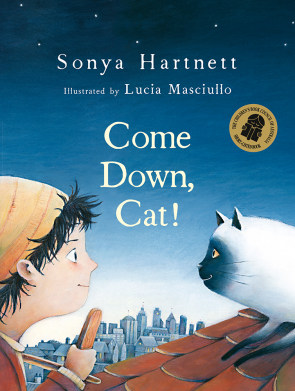
Introduce Come Down, Cat! by Sonya Hartnett, illustrated by Lucia Masciullo.
Discuss the cover. Where are the boy and the cat? How would you describe the expression on the cat’s face? The boy’s face?
Read the story to the whole class.
Afterwards, discuss the story with reference to the words used in the friendship word cloud. Revisit this cloud and the qualities of friendship that apply to the story. Have students finish these sentences:
- Nicholas is a good friend because …
- The cat is a good friend because …
Create a new word cloud by brainstorming words to describe Nicholas and the cat. Compare this with the original cloud.
Have students work in small groups to create a Venn diagram that sorts the words from the two word clouds. Place the common words in the centre.
Complete the activity by inviting students to contribute their ideas to a class Venn diagram.
Rich assessment task
Students draw a scene from the story and write FOUR key words that reflect the strength of Nicholas and his cat’s friendship. Words may be chosen from the word clouds and Venn diagrams.
Students will share their work in groups. Add the drawings to the class display.
Responding to the text
Display the drawings from the previous Rich Assessment Task and have students complete a gallery walk. Remind students to read the descriptive words around the drawings.
Invite students to share their work with the class and justify their scene and word choices.
Read the publisher’s synopsis for Come Down, Cat!. The synopsis suggests some of the themes in the book, including friendship and bravery. Discuss these themes as a class.
Talk about the ending of the book. Nicholas thinks the cat is brave, and the cat thinks the same of Nicholas.
Discuss who was brave and what each of the characters will think about their adventures in the morning.
Exploring plot, character, setting and theme
Interacting and relating to an image
Class discussion:
- Who is sitting close to me?
- Who is sitting halfway down the room?
- Who is at the back of the room?
- How can we look at people and objects?
- Face to face
- Looking up
- Looking down
- Looking sideways
Guide students to explore the angles created by the illustrator to position the reader within the text.
Students trace the angles that illustrate the contact Nicholas and the cat are making. Then in pairs they will mimic the angles, e.g. the cover is face to face, pp. 1–4 looking up, p. 10 looking down.
Students explore the text and describe the feelings the reader has when viewing different pages in the text (e.g. the cat leaping down into Nicholas’ arms, Nicholas gazing down at Cat). Think back to the major themes discussed after reading the synopsis.
Rich assessment task
Making connections with characters, events and own experience, sharing personal responses
Students will work in groups of three using an iPad or other device to take photos of each other, posing using selected angles from the text (e.g. face to face).
Each group shares their photos with the class and explains the angle and the feeling that it evokes.
Examples of photos from different angles should be printed, labeled and added to the class display alongside other work from this unit.
Examining text structure and organisation
Revisit earlier work by undertaking a gallery walk, looking at:
- the word clouds
- drawings
- photos
Discuss the feelings evoked by the photos from the previous Rich Assessment Task. Together identify illustrations from the text that depict the same angles as the photos.
Now discuss the structure of a narrative. Name the major components:
- orientation
- complication
- resolution
Relate this structure to Come Down, Cat! by rereading the text and identifying these three parts. Finally, discuss how the angles in the illustrations are used in each part of the narrative.
Examining grammar and vocabulary
What words or sounds does the cat make or say in the story? Explore the different meanings of ‘marl’ related to where it appears in the story (e.g. happy, worried, terrified).
What other sounds do cats make? Record these in a word cloud.
Play a compilation of cat sounds and noises, then invite students to add any new descriptive words to the cloud. What do students think the different sounds mean?
Add this work to the class display.
Rich assessment task
Revisit the structure of a narrative. Put students in small groups and allocate each group a section of the text. Students will work in their groups to list the key events for their allocated section and decide if they are part of the orientation, complication or resolution. Observe the discussions, noting if the groups use the illustrations as well as the text.
Have each group report back and discuss after rereading the text.
Come Down, Cat! revisited
Students should take part in a gallery walk to review their learning so far. Students may volunteer to share their work with the class, but should not be called upon to do so if they are not comfortable.
Help the class to cooperatively construct a story map for Come Down, Cat!.
Students will then work in groups with copies of the text to decide the six most important parts of the story. They should mark these parts with a sticky note and discuss the key elements.
Regroup as a class and invite each group to share and justify their choices. Through class discussion, agree upon the most important parts of the story note them on the story map.
Discuss the interaction of words and pictures and why, on one of the last pages in the book, there are no words at all.
Divide the story map into six squares and form six groups. Students will work in their groups to recreate one of the important events in words and pictures. They might like to include some of the sounds made by the cat with the appropriate expression.
The story map is assembled and displayed.
Rich assessment task
Give students six blank squares of paper.
The task is to retell Come Down, Cat! in six scenes. Have students list the key scenes they have selected then prepare the squares. They should then assemble these squares into a book. As an optional extra, they can create their own front cover.
When assessing, look for the main event, any details added and sequencing.

 (9 votes, average: 4.67 out of 5)
 Loading...