Connecting to prior knowledge
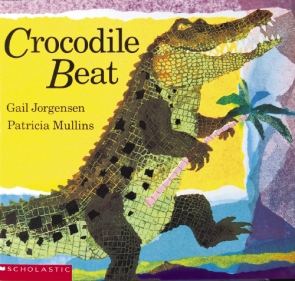
Show the front and back cover of Crocodile Beat to the class. Read the title. Ask:
- What kind of story are you expecting (e.g. scary)?
- We know what a crocodile is but what does ‘beat’ mean?
Have the students turn and talk to a partner and share some ideas about what the title might mean. Remind them that they can draw on the cover illustration and any prior knowledge about crocodiles.
Do a whole class share and begin a word wall for Crocodile Beat based on students’ suggestions. Before reading the book, listen and join in with the song ‘Never Smile at a Crocodile’ (performed by either Frank Churchill or Jay Laga’aia). Children may know the tune from Disney’s Peter Pan (1953) – you can hear it in this short clip. Discuss how the crocodile in the song/movie is depicted.
Make sure you have practised reading Crocodile Beat aloud ahead of time to get the rhythm and the beat right. Now that you have prepared, read the text right through with enthusiasm and ask again what ‘beat’ might mean. Compare responses to the original predictions.
Talk about the crocodile in the book. Ask:
- Are there any similarities to the crocodile in the song/movie?
- Why do you think crocodiles are portrayed this way?
- Have you read any books where the crocodile is a different kind of character?
Read the back cover of Crocodile Beat, which gives some information about the author and illustrator. Tell the students that Gail Jorgenson was a primary school teacher and this book was written in her classroom with her students. If you have access to other books by Jorgensen, collect and present them now, and encourage the students to talk about the author’s style.
Now read the blurb on the inside front cover. Here the book is described as ‘delightfully noisy’. Record this phrase on the Crocodile Beat word wall. Have a quick discussion about what the children understand the phrase to mean. There will be an opportunity to return to this later in the unit.
Exploring the text in context of our community, school and ‘me’
Most students will have seen the animals in this text before. In small groups ask the students to discuss the animals and where they have seen them – perhaps in another book, at the zoo, in family travel photos, etc. Move around and listen in to the conversations, prompting and reminding the students as to where they might have seen these animals. Have students make lists as follows:
| Animal | Where we have seen this animal |
| Crocodile | On TV, in picture books, at the movies |
| Ducks | |
| Elephants | |
| Monkeys | |
| Birds | |
| Lion | |
| Bears | |
| Snake |
When the lists are complete do a whole class share, helping students to notice that some of the characters in the book (e.g. ducks) are more likely to be seen than others (e.g. lion). Possible prompts:
- Which animals have been seen the most by children in the class?
- Where were they seen? What was the most common location?
Rich assessment task
Have students work individually to write one or two sentences about any animal from the book and where they saw it. Encourage students to refer to their lists and the word wall. The purpose for the writing is to add to the Crocodile Beat word wall.
Responding to the text
Making connections
Write the incomplete sentence below on the whiteboard:
When I heard/saw the part about … … …, it reminded me of … … ….
Model how to complete this sentence. You might write something like:
When I saw the part about the monkeys swinging and climbing, it reminded me of a trip to the zoo with my grandma.
Tell the students that, when you read Crocodile Beat this time, you want them to close their eyes and notice when something (an event, character, sound) in the story reminds them of another book or something that has happened to them. Let students record their responses using the sentence structure modelled.
Conclude by sharing some of the connections made by the students.
Sculptor and statue
Re-read the text. Allow students to join in as you re-read and they become familiar with the words and the beat.
In groups of four have students take on the role of:
- sculptor (one student)
- statue (two students)
- photographer (one student)
The sculptor directs the statues into freeze frames. They can select an action from the text for this, use one of the following suggestions:
- The lion: ‘I’m the king.’
- The bears clapping and dancing.
- ‘Watch out animals! Mean croc’s about’ (statues could depict the lion, bear or monkey).
The statues hold the pose for viewing. The photographer captures the freeze frame on an iPad. Then swap roles. Once everyone has had an opportunity to be the sculptor, provide time for the students to look at and discuss the photos in their groups. To conclude, share some of the photos with the whole class and ask:
- What freeze frame did you enjoy the most and why (e.g. perhaps the bears clapping and dancing because it is easy to be happy)?
- How did you know how to act like different animals (a lion, for example)? Prompt to help students articulate the knowledge they have of these animals from other books, TV, films, zoo visits, etc. as well as this text.
Exploring plot, character, setting and theme
The characters in this book are all animals. Create word cards for each animal and hand them out to small groups of four to five students.
The purpose of this activity is to have students discuss and write the sound each animal makes.
Before starting you might like to introduce the word onomatopoeia. Brainstorm a list of sounds animals make, such as ‘cows moo’, to illustrate.
Now model the activity using the ducks. You might write that ducks quack. Encourage the students to think of all the variations. Now look through the book to discover what the author used: ‘quack’, ‘quackity’, ‘splash’.
After your modelling, ask each group to write the sounds they think each animal makes. Then give each group a copy of the book to search for the way the author wrote the sounds. This can be done orally or recorded.
| Animal | Group | Author wrote |
| crocodile | splashing sound | Zzzzzzzzzz, SNAP! |
| duck | quack | quack, quackity, splash |
| elephant | ||
| monkey | ||
| bird | ||
| lion | ||
| bear | ||
| snake |
Afterwards, discuss:
- Which sounds were the same?
- Which were different?
- Does it matter?
Conclude by having each group find a photo or illustration of each of the animals from the book (they may need assistance to do this) and write a description of the sound it makes.
Rich assessment task
The sketch-to-stretch strategy helps students to visualise when reading and give a nonverbal response.
NOTE: Depending on your class, you might need to model this activity first. Try using ‘The Three Little Pigs’. After reading, quickly sketch three pigs: two with empty heads and the third with brains. Explain that you are thinking how smart the third pig was doing the extra work to build a strong house.
When you are ready, ask students to sit at their desks with a blank piece of paper. Explain that when you stop reading you want them to quickly ‘sketch’ what is in their head. That is, they are to draw what they are thinking about. If there is time they can add words. The purpose is to show their thinking.
Read the book aloud without showing the pictures. Give students four to five minutes to sketch what is in their head. Then invite them to share their sketches and their thinking in pairs.
From both the sketches and the explanation given, you can get an insight into what each student is comprehending.
Examining text structure and organisation
‘I wonder’
Prepare for this activity by choosing sections of the text that you can use to model a question (or a wonder) about the written or visual text. Prepare some ‘wonders’ for during and after reading.
Tell the students that you are going to read the book again and you want them to be aware of their thinking as you do so. Read and stop once or twice to model your thinking. For example, you might pause at the bear page and say, ‘I am wondering what happened to make the bears so happy that they are dancing around.’ Or towards the end, ‘I am wondering what the word ‘glint’ means.’ At the end, stop and share another ‘wonder’ such as, ‘I am wondering if there might be another crocodile waiting nearby.’
Give the students two or three sticky notes and a pencil. Before you read the book again, tell them they can write down something they are wondering about either during the reading or at the end.
Do a pair-share with the sticky notes before sharing some of the ‘wonders’ with the whole class. Students can put their ‘wonders’ on the Crocodile Beat word wall.
Explore the rhyme and rhythm
Ask students what they notice about the language Gail Jorgensen uses. They might comment on the rhyming words and rhythm.
Begin by giving some (or all) students rhythm sticks. You could also use drum sticks or a drum/tambourine. If none of these are unavailable, students can clap their hands, but the sticks will give a clear, sharp sound.
This book has a simple four-beat rhythm. Have students clap as you read.
Next explore the rhyme by identifying the rhyming words used. Record them:
- day/prey
- around/ground (on different pages)
- away/play (on different pages)
- king/sing
- around/sound
- din/in
- birds/word
- feet/beat
- grin/again
- about/doubt
- eye/bye-bye (on different pages)
NOTE: ‘Grin’ and ‘again’ are not a perfect rhyme; you may wish to omit this from your list.
Discuss these words, making sure the meaning is understood. Return to the text and read the trickier words like ‘prey’ in context. Let students infer the meaning.
Prepare the words on a sheet in no particular order:
| day | birds | din | beat | prey |
| around | king | feet | bye-bye | play |
| about | around | in | sound | doubt |
| away | word | eye | sing | ground |
In pairs, have students cut up the words and do a word sort. Make sure they can read all the words you have given them.
First ask the students to sort the words by finding rhyming pairs.
Next ask them to re-sort the rhyming pairs to make:
- one pile of word pairs that sound the same AND are spelled the same (king/sing)
- another pile of word pairs that have the same sound BUT different spelling (day/prey)
Compare and discuss. Some students might be able to add some rhyming pairs of their own. Add words to the Crocodile Beat word wall.
Examining grammar and vocabulary
Exploring adjectives
Prepare for this activity by drawing the silhouettes of five animals from the book on poster paper. Use the crocodile, duck, elephant, snake and monkey. Put the students in five groups, allocating one of the animals to each group.
Ask students to add labels describing their animal by drawing on their own knowledge, the book, the word wall and other resources that may be available. Provide each group with a copy of the book and encourage the students to study what the animals say and do so they can infer a description from the words. Also remind students to look closely at the illustrations.
Share the posters and add any new words that the rest of the class suggests. This activity could also be done on iPads using Popplet.
Now refer back to the first session (see Literature > Connecting to Prior Knowledge) and the words from the inside front cover: ‘delightfully noisy’. Check if the class can add to the original ideas about why the book was described in that way.
Display the posters and adjectives on the Crocodile Beat word wall.
Rich assessment task
Three-word summary
Model this first by reading Hattie and the Fox by Mem Fox. This book is also illustrated by Patricia Mullins using the same art techniques. The book has a similar theme to Crocodile Beat, except there is a fox after a hen for dinner! After reading, give your three-word summary and then justify the words you have chosen. These might be:
- ‘fear’, because on each page you were afraid the fox would get Hattie
- ‘friends’, because all the animals cared about Hattie
- ‘surprise’, because the cow frightened the fox with one single ‘moo’
Now read Crocodile Beat out loud. Ask each student to write their own three words to sum up the story. Then ask them to do a pair-share and justify the words they have chosen.
Assess by the words chosen and the justification given. The way students justify their words will indicate the connections they are making and the level of comprehension.
Focus on illustrations
Re-read the book and ask students to focus on the illustrations. Put the students in small groups of four to five. The groups should each have a copy of Crocodile Beat and/or another book illustrated by Patricia Mullins (see More Resources for examples). Ask the groups to study the illustrations and decide how they may have been created. You may like to have one group look at other picture books to identify other illustrators who use a similar technique (such as Eric Carle).
- What materials have been used?
- What is the effect of using torn paper?
Provide some coloured tissue paper and glue for the groups to collaboratively create an illustration. Ask each group to choose an animal that is NOT in Crocodile Beat but would fit with the story – perhaps a zebra or hippo – and create an illustration. If there is time they can add some scenery. Encourage students to look back at the book and the technique used.
Reader’s theatre
To practise and perform a simple reader’s theatre you will need groups of nine, consisting of a narrator and eight animals. The narrator will read the main text as the animals join in with the noise and actions. Select a student who is confident to read aloud to be the narrator.
Help students to prepare by doing a reading with a focus on punctuation. Before beginning, discuss the role of punctuation, particularly when reading orally as they will be doing now.
Demonstrate with the page that rhymes ‘birds’ with ‘word’.
- How many different forms of punctuation are there?
- What are they?
- What is the function of the comma, hyphen and exclamation mark? You may need to prompt students, as this might be difficult, although most will be eager to make a suggestion based on the context.
Have some fun reading this page with and without the punctuation.
Finish by turning back to the page with the lion, where the punctuation is a little more complex. Again, identify the various forms of punctuation and their function. Help students identify the speech marks and point out how that will help with the readers’ theatre. Read together and demonstrate. The ellipsis (…) might be new, though students may have noticed this form of punctuation in other books they have read. Help them to see how it is used to build tension. Again, read and demonstrate what this form of punctuation signals the reader to do.
Now put students into groups to prepare the reader’s theatre for Crocodile Beat. While one or two groups organise and practise their performance, another group could be practising with rhythm sticks (or similar instruments) to create sound effects and a musical accompaniment.
(AC9EFLA04) (AC9EFLE02) (AC9EFLE05)
Rich assessment task
Ask students to individually write a description to go with the torn tissue paper artwork they created earlier. Observe the vocabulary, use of the word wall and other resources, the structure used and the appropriateness of the punctuation attempted.