Connecting to prior knowledge
Before reading
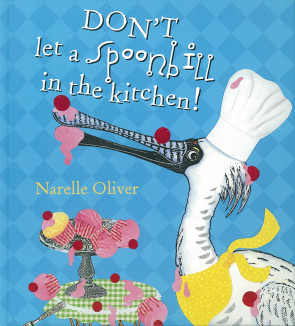
Look at the illustrations and title on the front cover and ask students to write or draw some predictions they have about the book and what may happen.
Key questions:
- The title is a warning. Why do you think the author is giving you a warning?
- What do you know about spoonbills?
- What does the name suggest about this bird?
- What mischief do you think a spoonbill could get up to in the kitchen?
After reading
Do a first reading of Narelle Oliver’s Don’t Let a Spoonbill in the Kitchen! for enjoyment. Have a discussion about the students’ initial reactions to the story and the chaos created by the different birds.
Key questions:
- Were your predictions right?
- Make a list of the different birds in the book (put aside for later).
- Have you ever had a messy time in the kitchen? What happened?
After the discussion, have students write and draw about a time when they accidentally made a mess in the kitchen, laundry, bathroom, etc. Share back to the class.
Drawing on prior knowledge
After modelling on the board, have the students draw a diagram of a bird they are familiar with. Encourage them to label any features that they know and possibly their function (as there is a direct link between the birds’ features and why each scenario in the book was chosen).
Key questions:
- Talk about the different kinds of birds in the book. Refer to your list.
- Have you seen any of these birds before? Where?
What are the main features of each bird in the book and what does the bird use them for? Add the answers to the list. For example:
The jacana has long legs and large webbed feet to walk on lilypads.
Exploring the text in context of our community, school and ‘me’
Connecting to the school environment
There will likely be many students who have not seen or heard of all of the birds in the book before. Take a walk around the school grounds and look and listen for the different types of birds in your area. Try to identify the birds.
Key questions:
- What kind of habitat was the bird in?
- Why is this the right habitat for this bird (food, shelter, water)?
Rich assessment task
Students choose a bird in the school environment as a focus. Have them draw a sketch of the bird and its habitat. Then have the students look for the food, shelter and water source. Alternatively, students can choose to research one of the birds from the book and put together the same information.
As a class, put the local information onto a simple map of the school and look at ways that these habitats can be cared for to protect the bird and ensure that they are not disturbed. Display any other research with the list already made.
Responding to the text
Responding to the illustrations
Look closely at the contrast in the illustrations between the birds and the places where they create havoc. The black and white linocut prints of the birds contrast with the colourful mixed media paper and photography collages.
Key questions:
- How do you think the illustrations were made?
- Are they photographs, paintings or drawings?
- Why do you think Narelle Oliver made the birds look different to the scenes where they aren’t supposed to be?
- Talk about how the birds contrast with their new environment. What effect does this have?
Explore some of Oliver’s other books and look at the similarities and differences in the illustrations. What do the students notice?
Responding to the events of the text
Put the class into six mixed ability groups and give each group a copy of the book, open to a page depicting a different bird:
- spoonbill
- cormorant
- pelican
- jacana
- stilt
- osprey
As a group have them complete a see, think, wonder activity and then share their ideas with the class.
Ask students if they think that the birds are having fun in the wrong places.
Key questions:
- What were the clues?
- Was it the illustrations, their prior knowledge about birds or something else?
Look at the final page about the birds sleeping over. Do a think-pair-share about what students think is going to happen next when someone comes home.
Key questions:
- What will they say?
- What will they do?
- What will happen to the birds?
- Who will have to clean up?
Responding by sharing opinions about characters and events
Responding to the humour in the text
Discuss the idea that this book was written to entertain.
Key questions:
- Do the students think that this was achieved?
- How was this achieved? Was it the words, the illustrations or the events?
- Was it all of these together?
Have the students recreate the part of the book that they thought was the funniest, using a range of materials to imitate Oliver’s mixed media style. They can do this on paper or digitally with an appropriate app or program. Ask them to explain why they thought that this was the funniest part.
Rich assessment task
As a class talk about the purpose of a review. Expose students to different book reviews and discuss how they can be useful. List the key elements. You can find some good examples from the following websites:
Have students complete a simple book review for Don’t Let a Spoonbill in the Kitchen! If required use the template (PDF, 174KB).
Examining text structure and organisation
Pattern and repetition
Draw the students’ attention to the pattern created on each page. Each page has two quatrains that has the same structure at the beginning:
- I see a …
- Now just in case you’re wondering if …
Choose another bird with an obvious feature and, as a class, innovate on the text and create a new page using the same structure. For example, a cockatoo with its crest on display shouldn’t be at the hairdresser.
Examining grammar and vocabulary
Rhyme
Re-read the book, emphasising the rhyming and encouraging children to join in and complete the rhyme in each quatrain. Discuss how rhyme and meter make it entertaining to listen and easy to listen and join in.
Rewrite one of the quatrains on the board and underline the rhyming words to highlight the rhyme at the end of every second line.
I see a pelican
Paddling in the sea,
With giant beak that’s like a bag,
She traps fish for her tea.
Students will work with a partner to complete a rhyming pairs activity by finding the rhyming pairs in the book. They will then come up with some rhyming words to add to the new page created in the last activity.
Similes
Apart from the spoonbill, every new bird features a simile (e.g. the jacana has feet ‘long and wide like snowshoes’). Discuss with students why the author might do this and how it contributes to the imagery and the story. How does the simile connect to the warning on the next page? For example, the cormorant has its wings stretched out ‘like all the washing pegged up in the sun outside’, and the warning is about the laundry.
Rich assessment task
Have students imagine that they are a bird flying up in the sky. If they have been on a plane before, or up a mountain, they may like to draw on this experience. Get them to visualise what the view would be like from up high. Make a list of very small things to compare this to (e.g. toothpicks, buttons, peanuts).
Key questions:
- What would they be able to see?
- How small would everything appear?
Help students create a simile about what they could see if they were a bird flying up in the sky:
From the sky I can see/feel … … … like … … …
They can then create a bird’s eye view drawing of what they have written about.
Retell familiar literary texts through performance, use of illustrations and images
Recreating familiar texts through performance
Divide the class into six groups and assign one of the birds from the book to each group. Talk about each bird first, providing a few facts about how they move. You may need to do a little research before this lesson.
One at a time, each group will imitate the movements of their assigned bird in its natural habitat until the teacher calls out ‘Freeze!’ Once they have paused for a moment, have the group then act out the bird in the wrong environment and get the class to guess which bird it is and where they are.
Create new texts through various media
Creating new texts
This book is all about warnings. As a class, brainstorm all the different places that you find warning signs. Many of these signs have pictures and few words. Look at a variety of examples and discuss why.
Key questions:
- Why do you think warning signs mainly contain pictures, not words?
- If you were travelling in a car, why might it be better to have mainly pictures instead of lots of writing?
- If you were visiting another country, would this be helpful? Why?
- Why do you think the colour/shape/picture was chosen?
Show the students a range of warning signs (PDF, 107KB) and get them to guess what the hazard is.
Ask students to make up their own warning signs, thinking carefully about the best shape, colour, image and writing to get their message across as easily and effectively as possible.
Rich assessment task
Get students to think of their favourite animal and a place where it could create a lot of mayhem. Help them to create a black and white picture of this animal in the style of Narelle Oliver’s linocuts, cut it out and paste it onto a collage (also prepared by the students) depicting the animal in the wrong environment. This will require access to scrapbook paper, magazine pictures and other materials that students can cut up.
Using this collage, students will create a warning page in the style of Don’t Let a Spoonbill in the Kitchen!.

 (3 votes, average: 4.00 out of 5)
 Loading...