Downloadable PDFs
PARENTS AND CAREGIVERS LOWER PRIMARY upper primary
Activities in this section
1. Parents and caregivers
NOTE: This resource uses the term ‘soccer’ rather than ‘football’ to distinguish the sport from Australian rules, rugby league, and rugby union football.
Connecting to prior knowledge
Soccer snap
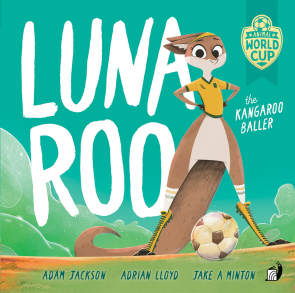
Use the provided cards (PDF, 174KB) to play soccer snap with your child. This game will help develop prior knowledge of the language of soccer before reading Luna Roo the Kangaroo Baller. Use the blanks to draw your own soccer snap cards. These could include the names of favourite soccer players, a local soccer team, and any other words your child might associate with soccer.
While playing, discuss some of the words on the cards. Ask your child if they have heard the words before. Explain these as you go, acting out any words that include actions. This will allow your child to understand some of the key terms from the book before reading, and may aid their comprehension. If you need help explaining some of the terms, you can consult Twinkl’s list of soccer language.
Exploring the text in context of our community, school, and ‘me’
A sports family tree
Draw a sports family tree with your child. Begin with the trunk, writing your child’s name and asking them what sport they like. Write this too, then write the name and favourite sport of each of your family members on a different branch. Discuss why each person might enjoy that sport. Note the similarities and differences between family members.
If there are people in your family who support rival teams, invite children to talk about this. The picture book My Big Secret by Felice Arena will support this discussion about difference and acceptance.
Back to top
2. Lower primary (F–2)
NOTE: This resource uses the term ‘soccer’ rather than ‘football’ to distinguish the sport from Australian rules, rugby league, and rugby union football.
Connecting to prior knowledge
Soccer pitch model
On a large sheet of paper, draw a soccer pitch. Give students several sticky notes and ask them to write or draw things they might find on a soccer pitch. Alternatively, you could provide cut-outs of items or people (e.g. ball, goals, boots, water bottle, player, referee) and ask students to identify them. They could then take turns sticking the cut-outs to the pitch.
Once students have shared their ideas, write the following terms on the board for further discussion:
- Coach
- Captain/skipper
- Winger
- Stands
- Midfield
- Referee/ref
- Ball
- Goals
Australian animal sports trading cards
In this activity, students will design sports trading cards for Australian animals. Begin by describing what a trading card is and show some examples (students may be familiar with Pokémon cards). Explain that a sports trading card profiles one player and describes some of their achievements or skills.
Next, draw a table with two columns: one labelled ‘Animal’ and the other ‘Skills’. As a class, brainstorm different Australian animals and some of their physical skills or behaviours that might make them good at different sports. For example:
| Animal | Skills |
| Kangaroo | Jumping, kicking, boxing |
| Koala | Climbing, sleeping |
| Wombat | Burrowing |
| Cockatoo | Flying, learning tricks |
| Emu | Running |
| Platypus | Swimming |
After brainstorming, provide each student with a sports trading card template to complete (PDF, 99KB). You can differentiate this activity by focusing on drawing the animal rather than writing the skills. To finalise the lesson, allow students to share their cards with the class.
Exploring the text in context of our community, school, and ‘me’
Sports classmate bingo
As a class, brainstorm and list as many sports as possible. Then distribute copies of the bingo grid (PDF, 78KB). You may wish to print this on A3 paper to allow more room to write. Ask each student to choose nine sports from the class list and write or draw one sport in each square.
Once everyone has prepared their grid, explain the activity:
- Walk around the room and find a classmate. Ask your classmate if they have played any of the sports on your grid.
- If the classmate has played one of the sports on your grid, they can write their name in that square and you can mark that square as completed.
- Continue talking to different people until you have completed all nine squares on your grid. Once you have done so, return to your seat.
Consolidate this task by asking students to name a classmate from their grid. Invite those students to explain the rules or the reasons they enjoy that sport.
Three-page stories
If possible, read All The Ways To Be Smart written by Davina Bell and illustrated by Allison Colpoys. This is a good way to introduce the next activity, but is not required. If you have access to StoryBox Hub, a reading is also available there.
As a class, brainstorm a list of skills that someone can learn, drawing on ideas from the book (if you read it) as well as examples from students’ own lives. These can be skills that students have already learned or that they hope to learn, such as riding a bike, sailing a boat, holding your breath underwater, or counting to ten. Record the brainstorm for future reference.
Ask students to think about one skill that they have learnt to do. Explain that learning to do something is an achievement. Students will be creating a three-page story based on one of their own achievements.
Provide each child with a sheet of A4 paper folded in half. Guide them through the following steps to make the three-page story:
- The front cover is for the title of the story. Students could write a title such as ‘When I learnt to …’
- On the first internal page (on the left), students should draw how they felt or what they thought about when they wanted to learn how to do something.
- On the second internal page (on the right), students should draw themselves learning how to do their chosen task.
- Finally, on the back page, students should draw themselves achieving the task and how they felt.
Invite students to share their completed story with other class members. Reflect on the range of emotions expressed as students learned a new skill. Connect this to the different emotions Luna will express when you read her story.
Back to top
3. Upper primary (3–6)
NOTE: This resource uses the term ‘soccer’ rather than ‘football’ to distinguish the sport from Australian rules, rugby league, and rugby union football.
Connecting to prior knowledge
Soccer vocabulary ball
Read out the following list of soccer vocabulary, but don’t provide the definitions yet. Students should write down any words they know the meaning of on a soccer ball (PDF, 81KB). If they don’t know a word, they don’t write it down. You might like to display each word so that students can see the correct spelling.
| Soccer vocabulary | Definition |
| World Cup | A famous soccer tournament that happens every four years. The best teams from all over the world compete to become the champion. |
| FC | The initials for ‘Football Club’. |
| Captain | The player who leads the team and helps them listen to the coach. |
| Skipper | Another name for the captain. |
| Winger | A player who runs up the left or right side (or ‘wing’) of the pitch. |
| First touch | The first action a player takes when they receive the ball. |
| Scoring a goal | When a player kicks or heads the entire ball into the opposing team’s goal. |
| Half-time | The 15-minute break in the middle of a game. |
| Stands | The benches where fans sit to watch the game. |
| Coach | The person who trains, supports, and mentors the team and gives them instructions and encouragement during a game. |
| Intercepting | When a player blocks or steals the ball while the other team is trying to pass it. |
| Passing | Kicking a ball to a teammate. |
| Midfield | The area in the middle of the soccer pitch. |
| Striker | The player whose job is to score goals. |
| Heading | Hitting the ball with your forehead. |
| Ref | The referee; the person who oversees the game and makes sure everyone follows the rules. |
| Full-time | The end of the match. |
| Baller | A way to say that someone is an amazing soccer player. |
Once students have recorded the known words, ask them to move around the classroom while you play some music. When the music stops, students will pair up and share the definition of a word they know. If they are missing a word or definition, they can write it down and continue to circulate.
Repeat this process until everyone has filled their soccer balls with vocabulary that they understand. To complete this task, come together as a class and share the definitions of all the words.
Ask a soccer expert
Write the following headings along the top of the whiteboard:
- Places
- People
- Rules
- History
- General facts
Ask students to suggest some questions that they could ask a soccer expert. Work together to group similar questions and place them under the relevant headings. Then vote for the best five to ten questions as a class.
Make a list of potential soccer experts such as local coaches, a sports teacher, students who love soccer, or even a professional player! You can also search for your local club using Football Australia’s website. As a class, compose a formal letter requesting answers to your questions. Discuss how and why the invitation needs to be formal.
When the answers come in, share them with the whole class to develop their prior knowledge of soccer.
Exploring the text in context of our community, school, and ‘me’
The Matildas’ character strengths
For this activity, students will watch celebration videos featuring Matildas players who have reached the 100-cap milestone, meaning that they have played for the Australian women’s soccer team at an international level 100 times. In the videos, family and friends describe the capped player and their strengths.
As students watch the videos, they will need to list some of the ways the players are described by their family and friends, such as ‘hard-working’, ‘positive’, ‘humble’, ‘kind’, etc. They might work in small groups to watch a video of their choice, or the whole class can watch one or two videos together.
Once students have written their lists, invite them to share some of the words that were used in the videos. Discuss as a class which descriptions were used most often. Ask students to infer why these might be common descriptions for elite sports people.
Connect this activity to students’ lives by asking them to describe some of their own character strengths.
How soccer is like my sport
Introduce or revise the concept of a Venn diagram. Then ask students to create their own. One circle will be for soccer and the other will be for a sport of their choosing. This could be something they play themselves or something they are generally interested in. Brainstorm a list together to provide some options. They don’t all have to be ball games – there are athletics, water sports, gymnastics, and many more to choose from!
Students should write any similarities between the two sports in the middle of the diagram (where the circles overlap), and any differences in the outer circles. Prompt students to think about the attributes of their chosen sport by asking them to consider:
- Where the sport is played
- What equipment is needed
- If and how points are scored
- How many people are in a team
- What spectators do
- When it is played (in a particular season, at a special event)
To support students in this activity, you may need to allow time for research. Direct them to Britannica Kids and other age-appropriate sites for more information about soccer or their chosen sport.
To conclude, invite students to share what they wrote on their Venn diagrams.
Back to top
Activities in this section
1. Parents and caregivers
NOTE: For the purpose of tracking page numbers, the first double-page spread of the story is considered pp. 1–2.
Responding to the text
Commentate your own story
After reading Luna Roo with your child, explain that you are going to go back through the book. This time, pretend that you are commentating the game instead of Jeff and Gary (the galahs).
As you flip through the pages with your child, commentate on what is occurring in the story. Do this without reading the written text; instead, use this as a time to retell the story and have fun describing the events that stood out to you and your child. Allow your child to help commentate the story, including any details they remember.
Exploring plot, character, setting and theme
Resilience
Read pp. 15–16 where Luna ‘shakes off her doubts’.
Ask your child what it means to ‘shake off your doubts’. This is an expression that means to let go of your worries and fears and not let them get to you.
Create a visual description of this expression with sticky notes and a soft toy. Ask your child what worries the soft toy might have. These might include:
- ‘No one plays with me’
- ‘The other toys are more colourful’
- ‘I am not the cuddliest’
Write the soft toy’s worries on sticky notes and attach them to the toy. Then explain that you are going to shake the worries off. With your child, gently shake the soft toy so that all the sticky notes fall off.
Talk to your child about how the story might have been different if Luna hadn’t shaken off her worries and doubts. Because Luna shook off her doubts, she was in better shape to win the game.
Back to top
2. Lower primary (F–2)
NOTE: For the purpose of tracking page numbers, the first double-page spread of the story is considered pp. 1–2.
Responding to the text
Soccer ball feelings
For this activity you will need a soccer ball.
After reading Luna Roo the Kangaroo Baller, ask the class to sit in a circle. Explain that, in the story, Luna expresses many different feelings. Tell students that they will be rolling the soccer ball to one another. When a student receives the ball, they will name a feeling that Luna may have experienced. When they pass the ball to someone else, that person will respond with an example of the named feeling from the story.
Make a list of some of the emotions Luna felt to prompt students. Explain that if they receive the ball but cannot recall an event or emotion, they can pass the ball to someone else.
Record the feelings and events that the students nominate. Once most children have had an opportunity to pass the ball, review both lists. You might like to explore how to work through some of the feelings, depending on time and your class context.
Popsicle stick puppet retell
As a class, list the characters in the book. This should include:
- Luna Roo
- Jeff and Gary (the galahs)
- Bush United:
- Brown Snake
- Red-Bellied Black Snake
- Emu
- Huntsman
- Platypus (pictured on pp. 8, 18, 20)
- Tasmanian Devil (pictured on p. 20)
- FC Outback (Luna’s team):
- Crocodile (pictured on pp. 6, 16, 19, 23)
- Cassowary (pictured on pp. 6, 16, 20)
- Dingo (pictured on pp. 6, 16, 18, 20)
- Wombat (pictured on pp. 6, 16, 19, 23)
- Koala (pictured on pp. 10, 12, 16, 19, 24)
- Echidna (pictured on pp. 15, 20, 21)
- The crowd
- The magpie ref
- Hawkeye
Place the students into groups and assign characters. Ask them to draw these characters, cut them out, and glue them to popsicle sticks to make mini puppets.
Once they have finished, ask each group to use the puppets to retell the story or develop a sequel to the story.
An alternative or optional extension could be to create new characters and come up with an original story about another match or sport.
Exploring plot, character, setting and theme
Race around the plot
Create a short course for students with 13 cones along a track. On each cone, write a plot point from Luna Roo:
- Luna makes captain.
- Emu takes the ball from Luna.
- Koala stops the goal.
- Luna takes the ball halfway.
- Brown Snake steals the ball and scores a goal.
- It is half-time and the crowd boos Luna.
- Luna inspires her team to win.
- Luna intercepts a pass.
- Luna passes the ball to Dingo, who scores.
- Luna’s team scores another goal.
- Brown Snake heads the ball to the goal, but Luna kicks it out.
- Hawkeye calls no goal.
- Full-time whistle blows and the crowd cheers for Luna.
Students need to move around the course. At each plot point, they need to stop and act out what happened.
Ask the students to reflect on Luna’s development throughout the story. Encourage discussion by asking:
- What different emotions did Luna feel throughout the story?
- What was the most challenging plot point for Luna?
- When did Luna feel the happiest?
- What made Luna doubt herself?
- How did Luna change during the story?
A Luna-shaped hero
For this activity, you will need three different coloured markers. Draw Luna at the centre of a mind map. Read Luna Roo to the class again. Each time a student sees or hears a word or phrase that describes Luna, ask them to raise their hand and explain it. Then add the word or phrase to the mind map. Colour code the descriptions depending on whether they came from:
- Luna
- Jeff and Gary
- The crowd
After recording the descriptions, ask students what patterns they notice.
Explain the colour coding you have used. Indicate that Luna’s descriptions of her own ability (e.g. ‘the victory is well within our reach’, p. 15) are examples of positive self-talk, whereas descriptions from Jeff and Gary in the first half of the book are negative (e.g. ‘Luna’s looking out of place’, p. 10). Reflect on the fact that what we say to ourselves can impact how we behave. Reiterate that what others say about us can impact us, but only if we let it.
Back to top
3. Upper primary (3–6)
NOTE: For the purpose of tracking page numbers, the first double-page spread of the story is considered pp. 1–2.
Responding to the text
The sport report
After reading Luna Roo the Kangaroo Baller, explain to the class that they will be devising a sport report that describes the match that occurs in the book. Provide some examples of sport reporting by watching the following videos. Allow students to make note of any descriptive language and facts that are mentioned.
- Behind the News – Find out who won the AFL, NRL and NRLW Grand Finals (up to 01:40)
- Paralympic Games – Wheelchair Rugby Highlights | Paris 2024 Paralympic Games
- 10 News – Australia Socceroos Close In On World Cup Berth After Stunning Japan
Discuss some of the features of the videos, including:
- Specific details (e.g. number of fans, names of players and teams, final score, any ‘firsts’)
- Descriptive language (e.g. ‘nail-biting’, ‘thrilling’, ‘unbelievable’)
Allow time for students to improvise their sport reports in small groups. They may find it useful to write a short script. Once they have developed a sport report, allow them to present these to the class or another group.
Luna’s story
Most of the action in Luna Roo is narrated by Jeff and Gary (the galahs). Place students in groups and assign each group a double-page spread from the book. Ask students to rewrite the action on these pages from Luna’s perspective. Explain that they will need to include many ‘I’ statements and describe how Luna is feeling, what she is thinking, and what questions she might be asking.
Students will then present their work to the rest of the class. To do this, ask each group to assign roles: some students will perform Luna’s inner monologue and some will hold the rewritten text alongside the original. Ask the groups to stand in page order. They will present their work one at a time, displaying the pages and acting out Luna’s inner thoughts, feelings, and questions.
Discuss if and how the new point of view brings the reader closer to Luna’s emotions and feelings.
(AC9E5LE03) (AC9E5LE05) (AC9E5LY06)
Exploring plot, character, setting and theme
Heroes like Luna
Ask students to reflect on what makes Luna the hero of the story and not the brown snake. Discuss and list Luna’s attributes. Ask students to consider whether it is significant that Luna is portrayed as young and female. Following this, watch the BTN clip about the Matildas’ climb to fame during the 2023 World Cup.
Reflect on some of the similarities between Luna and the Matildas. Then have students create a character profile for Luna. They should write her name in the centre of a page and list her attributes around the outside. Prompt students to include descriptions of her character and how it changes throughout the story.
Plot map
Provide pairs or individual students with a diagram of a soccer pitch. Read the book aloud again and have students record the key plot points on or around the pitch. Students will need to summarise the action of each plot point. At the conclusion of this task, they should have the following plot points recorded:
- Luna makes captain.
- Emu takes the ball from Luna.
- Koala stops the goal.
- Luna takes the ball halfway.
- Brown Snake steals the ball and scores a goal.
- It is half-time and the crowd boos Luna.
- Luna inspires her team to win.
- Luna intercepts a pass.
- Luna passes the ball to Dingo, who scores.
- Luna’s team scores another goal.
- Brown Snake heads the ball to the goal, but Luna kicks it out.
- Hawkeye calls no goal.
- Full-time whistle blows and the crowd cheers for Luna.
Ask students to reflect on which plot points were easiest to summarise and which were more difficult. Invite them to share any strategies that helped them to create their summaries.
Back to top
Activities in this section
1. Lower primary (F–2)
Examining text structure and organisation
Predicting a problem
Remind students that a key part of a narrative is the complication (the main problem). Explain that good writers might hint at the complication with a technique called foreshadowing. Foreshadowing is when an author or illustrator provides clues about the complication of the story. Reread the first three double-page spreads of Luna Roo and ask students to raise their hand if they notice some clues/foreshadowing that might suggest the problem/complication.
Provide an example from p. 2 by explaining that the sentence ‘Two teams will bring the fight’ hints that there will be a battle, and not necessarily a clean win for one team. Other statements that demonstrate foreshadowing include:
- ‘Two teams will bring the heat and fire’ (p. 2)
- ‘Ambitions are ignited’ (p. 2)
- ‘startling news’ (p. 3)
- ‘surprisingly been dropped’ (p. 4)
- ‘But what a risk’ (p. 5)
NOTE: Additional scaffolding and explanation may be needed for younger students.
Vectors and movement
In still images, illustrators suggest movement using lines or vectors. Turn to pp. 9–10 where Luna is ‘oozing confidence’. Ask students to move like Luna is moving on this page. Then ask them to move like the koala goalie on the opposite page. Ask students to reflect on how they knew what the movements should look like when both of these images are still.
Now point out the vectors (the lines illustrating movement) on these pages:
- The blurring on Luna’s side demonstrates that she has moved from one direction to another; the angle of her body and ears show movement to the side.
- The blurred emu with lots of straight horizontal lines shows movement. The lines to the left of the ball show where the ball has come from.
Go through the next few pages and ask students to identify the vectors and note the characters that appear stationary.
Examining grammar and vocabulary
Idioms
In Luna Roo, the authors use idioms. Idioms are expressions that are commonly used and have a meaning that isn’t literally expressed.
Share the example on p. 5: ‘a girl so green’. Explain that this means that Luna is new or young, like plant shoots. It doesn’t mean that Luna is literally green!
Next, turn to p. 18 and ask students to identify the idiom on this page (‘put it on a plate’). Challenge students to explain this idiom to a partner, then invite them to share their ideas with the rest of the class.
Adverbs
Reread p. 23 where the game moves into added time. Ask the students to act out how the emu is moving, then how the brown snake is moving.
Ask students to vote for the animal whose movement was best described in the book, or whose movement was the easiest to copy. Prepare the following table on the whiteboard and fill it in as a class:
| Who (noun) | Moved (verb) | How (adverbial phrase) |
| Emu | skipping | |
| Brown Snake | leaps | with a mighty spring |
Explain that authors sometimes add detail to actions/happenings or verbs. This detail is called an adverb because it ‘adds to the verb’. When this is presented as a group of words, it is called an adverbial phrase.
Challenge students to write an adverbial phrase to describe how the emu might have been skipping. Brainstorm some adverbs to assist them with this task, such as:
- carefully
- quickly
- with speed
- very fast
- with grace
Depending on your students’ age and needs, you could adapt this activity to construct the adverbial phrases orally rather than in writing.
Back to top
2. Upper primary (3–6)
Examining text structure and organisation
Character and narrative structure
Focus on the full title of the book: Luna Roo the Kangaroo Baller. Highlight Luna and her soccer experience as key to the structure of this narrative. Revise the parts of a narrative with your students, drawing on their prior knowledge of the orientation (sets the scene for the reader), complication (when a problem occurs), and resolution (when the problem is resolved).
Students will work in pairs to complete the character and structure worksheet (PDF, 80KB), matching the excerpts from the book to Luna’s feelings and the correct stages of the narrative. Students can then share their responses with the rest of the class. Prompt students to consider how Luna’s responses to the events move the story along.
Fonts and meaning
Luna Roo uses a variety of fonts to emphasise ideas and express actions. Display the cover and highlight the text that reads ‘Luna Roo’. The size of the text and the use of bold and capital letters make the title salient, meaning that it stands out. Ask students to consider why ‘Luna Roo’ is larger than ‘the Kangaroo Baller’. Prompt them by reminding them that Luna Roo is the main character in this book.
Read through the book again. As you do so, students will record any salient words and explain why they think this word was made salient on the page. For example:
| Salient word | Explanation |
| Dropped | Emphasising the shock that the captain has been removed |
| Burst | Describing the suddenness of Luna becoming captain |
| Skippy | Emphasising how young Luna is |
Examining grammar and vocabulary
Juxtaposition
Split the class into two groups. Explain that you are going to have an ‘opposite battle’. One group will go first by saying a describing word. The other group will need to quickly think of the opposite word and call it out. Some ideas to prompt students’ thinking are:
- Hot / cold
- Tall / short
- Fast / slow
- Straight / curly
- Good / evil
After some time, ask students to swap sides and continue the opposite battle.
Explain that when two opposites are mentioned close together, it is called juxtaposition and it can provide contrast in a story.
Focus on the first two sentences of Luna Roo (p. 2). Ask students to discuss the juxtaposition in these sentences. Ask:
- What juxtaposition can you see in these two sentences? (e.g. cold and hot)
- Why do you think the authors chose this juxtaposition to set the scene? (e.g. to build anticipation for the game)
- How does this juxtaposition build anticipation? (e.g. there is a change coming, from cold to hot)
- Do you notice any other juxtapositions in the book? (e.g. young Luna and the experienced previous captain; deadly Bush United and naïve FC Outback)
Precise vocabulary
Focus on the third sentence on p. 15: ‘Huddled together, her team absorbs her rousing speech.’ Explain to the class that there are several parts to this sentence. Use the following table and colour coding to explain the parts of this sentence:
| Huddled together, | her team | absorbs | her rousing speech. |
| How/where
Adverbial group |
Who
Noun group |
What’s happening
Verb |
What
Noun group |
Next, highlight the use of the precise vocabulary: ‘huddled together’, ‘absorbs’, and ‘rousing’. Explain that students will need to explore the meaning of this vocabulary and other words that could be used instead (synonyms). For example, ‘huddled together’ means standing close to each other. Other words (synonyms) that could be used are ‘standing close together’. Provide students with the precise vocabulary worksheet (PDF, 81KB) to complete.
Ask them what has changed between the original and rewritten descriptions. Explore the use of precise vocabulary to provide a specific meaning.
Back to top
Activities in this section
1. Lower primary (F–2)
Luna’s backstory
In this task, students will work in groups of three to four to create a short performance that explains how Luna came to be the captain of FC Outback. This is called the backstory: the events that occurred before the action described in the book. Students may choose the characters they wish to portray, and can even invent new characters to suit the backstory. Options include:
- Luna
- The coach of FC Outback
- Luna’s teammates (Crocodile, Cassowary, Dingo, Wombat, Koala, Echidna)
- A different friend or family member
- The previous captain of FC Outback
Discuss reasons why Luna may have been made captain. Provide students with the following quotes from Luna Roo to support their reasoning:
- ‘Ambitions are ignited’ (p. 2)
- ‘Their skipper of 10 years has surprisingly been dropped’ (p. 4)
- ‘Luna Roo has burst onto the scene’ (p. 5)
- ‘She’s too young to be a captain’ (p. 6)
- ‘Luna’s oozing confidence’ (p. 9)
Allow time for students to plan and rehearse their short performance, then present them to the class.
Trials to triumph comic strip
Tell students that they are going to create their own comic strip inspired by the themes of Luna Roo. This video may be useful to introduce the process; pause as needed to explain the steps. You can also consult this guide from BBC Bitesize.
Provide students with two templates (PDF, 84KB) and explain that they should use one to plan their comic and one to publish the final product. You may wish to print this on A3 paper to allow more room.
Remind students that Luna Roo is a story about overcoming adversity to achieve a goal. For this task, students must create a character who starts out confident; then faces a problem that causes them to doubt their own abilities; and finally musters inner strength to achieve their goal.
Students will need to select an animal to be the main character of their comic strip. This may be drawn from the earlier Sports Trading Cards activity (under Literature > Connecting to Prior Knowledge). Students will also need to give their character a task, skill, or goal to accomplish. Review the brainstorm from the Three-Page Stories for more ideas (under Literature > Exploring the Text in Context of Our Community, School, and ‘Me’).
Guide students to use the comic strip template to develop their narrative. Celebrate the completed comic strips by sharing and displaying them in class.
Back to top
2. Upper primary (3–6)
Commentating texts
Remind students that most of the action in Luna Roo is narrated by Jeff and Gary. As sports commentators, their job is to describe what is happening for the spectators at the game. However, the first and last pages of the story address the reader directly, as if they are also spectating the game. These pages are written in the second person. Point out the word ‘you’re’ on p. 2, and the words ‘you’ and ‘your’ on p. 29, which signal this perspective.
Tell students that they are going to pretend to be commentators for some simple fairytales. Place them in small groups and assign different fairytales such as:
- ‘The Three Little Pigs’
- ‘Goldilocks and the Three Bears’
- ‘Little Red Riding Hood’
- ‘The Gingerbread Man’
Explain that students will have to imagine that they are narrating the events of the fairytale to a group of spectators. This means that they need to use words such as ‘you’ and ‘your’ to involve the spectators in the action, rather than just recounting events in the third person (using words such as ‘he’, ‘she’, and ‘they’).
As a class, brainstorm different types of commentators who might address an audience using second-person language. These might include:
- A sports commentator (pretending that the fairytale is a sporting event)
- A TV host (pretending that the fairytale is a reality, game, or talk show)
- A journalist (pretending that the fairytale is a news report)
Allow time for students to plan and rehearse their commentaries. Each group member should have a role, with one or two people acting as commentators and the others as spectators, fairytale characters, and so on. Students could record their commentaries as video or audio and share them with the rest of the class.
Main character energy
Students are to write a short narrative in a similar style to Luna Roo, with themselves as the main character. They will need to choose a skill, task, or goal to work towards in the narrative. Ideally this will be drawn from their own experiences; you can brainstorm ideas as a class. Explain that their character will need to have emotional responses to help move the story along, as explored in the Character and Narrative Structure activity (under Examining > Examining Text Structure and Organisation).
Provide students with the following guidelines to scaffold their writing:
- Introduce the main character and the skill/task/goal they are overly confident about
- Include some doubting comments from other characters
- Allow the main character to fail when they first attempt the skill/task/goal
- Allow the failure to become motivation for the character to change their approach or get assistance
- Allow the main character to succeed in their skill/task/goal
Encourage students to plan and edit their work before writing the final copy. Celebrate the completed narratives by sharing and displaying them in class.