Connecting to prior knowledge
Ned Kelly is an infamous Australian bushranger whose life and death may be known to some students prior to reading this book. Determine the knowledge base by asking a few questions; if little is known about this character, begin with some research around bushrangers in general. Provide time in the library for pairs of students to research this topic. Guide them to look at various sources of information, including newspaper accounts and artwork. Each pair should return to the class with three or four key facts.
As a way of finding out students’ prior knowledge and/or beliefs about Ned Kelly, ask them to create a character portrait of him. Before showing students the book, ask them to close their eyes and picture Ned Kelly, focusing on his looks and character traits from what they have previously read/seen/heard about him. Direct students to now draw Ned Kelly. Around the outside of their picture, students can write words describing his appearance and characteristics (e.g. thoughts, feelings, emotions, values, beliefs) as well as any other information that they might know about Ned Kelly.
- What are the similarities? For example, both Nolan and Lessac produce uncomplicated images, using a direct vision.
- What are the differences? For example:
- Nolan paints Ned Kelly as a dark tin man, whereas Lessac provides more facial features.
- Nolan gives as much space to the landscape as he does to the main character, whereas Lessac gives more space to the character and less to the landscape.
- Nolan lets us see the world from Ned Kelly’s perspective, while Lessac allows us to see him from the viewer’s perspective.
- What might these images portray about Ned Kelly and the era in which he lived and died?
- Do the paintings of Nolan and Lessac tell different stories?
- Mark Greenwood’s book title mentions a green sash. Did anyone notice a green sash in any paintings? What might be the connection to the green sash? Explore what the children know about sashes (e.g. worn by pageant winners, Boy Scouts and Girl Guides, people celebrating a birthday).
On completion, work as a class to compile prior knowledge into a word list that can be referred to throughout the reading of the book.
Exploring the text in context of our community, school and ‘me’
Using Google Maps or a map of Australia, invite students to nominate the towns/states/areas where they believe bushrangers lived and ‘worked’.
Pose the question:
Did bushrangers live in every state/territory in Australia?
Ask the children to brainstorm keywords to use in a search engine to answer this question. Then ask the students if they know the names of other infamous Australian bushrangers (e.g. Ben Hall, Captain Thunderbolt, Dan ‘Mad Dog’ Morgan). Talk about the word ‘infamous’.
Students work in small groups to complete their research and add their findings to a class map.
As a class discuss why Australian bushrangers lived and worked in certain areas.
Rich assessment task
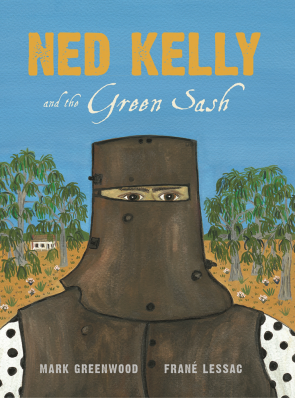
Show students the front cover of Ned Kelly and the Green Sash, drawing attention to Lessac’s illustration. Pose questions for a class discussion:
- What do you notice about the cover image?
- Why do you think the picture of Ned Kelly is so large?
- What do you notice about the background?
Discuss with students who they believe are real life heroes. List these people and place them into groups if applicable (e.g. professions like emergency services). Pose the question:
What makes each one of these people a hero?
Record the criteria given. Complete this discussion again, but this time focusing on villains. From both lists agree upon the characteristics, qualities, actions and effect on others of both a hero and villain.
Distribute the two-box prediction sheet (PDF, 89KB). Explain that students will each be writing a prediction on what they think might happen in the book using their prior knowledge of Ned Kelly and sentence starters such as:
- I think … … … because … … …
- I believe … … … because … … …
Allow time to complete this stimulus sheet before asking students to share their predictions, either as a whole class or in a pair-share buddy chat.
Once students have shared with each other, bring their attention back to the book. Remind students that prior to reading we are able to gain further information on what a book is about by reading the blurb. After reading the blurb aloud, ask them to complete the second prediction box using the new information they have about the part of Ned Kelly’s life the book is going to cover.
Responding to the text
Read up to the pages where Ned Kelly receives the green sash from Mr Shelton. In pairs, have students create a freeze frame of Mr Shelton giving and Ned Kelly receiving the sash. Ask them to think about how each of the characters were feeling. Then ask students to complete a think-pair-share focusing on their prior thoughts on Ned Kelly and the questions below:
- What characteristics did you picture Ned Kelly having as a young boy?
- Was this opinion different to what you have now learnt about Ned Kelly? If so, how?
- What words would you use to describe Ned Kelly as a child?
Set up two corners of the classroom with signs that read ‘Agree’ and ‘Disagree’ for a classroom debate on Ned Kelly as a child. Read out the statements below one at a time and ask students to move to the corner of the room best fits their interpretation of the statement based on what they have learned so far.
- Ned Kelly was a hard worker.
- Ned Kelly cared deeply about his family.
- Ned Kelly was thoughtful.
- Ned Kelly was brave.
Invite students to justify their position on each statement. To conclude, ask them to add a statement to a class display or shared online platform about Ned Kelly’s attributes as a child. Students can either make a declaration, reinforce someone else’s stance, or rebut an opinion with which they disagree.
Exploring plot, character, setting and theme
Before reading the remainder of the story, tell students that this book is described as a non-fiction narrative. Discuss what this means. Discuss other books that may fit into this category, e.g. Flood* by Jackie French, illustrated by Bruce Whatley.
* Reading Australia title
Then, as a whole class, make a list of the main characters that are included in this story. Brainstorm how the characters are linked to Ned Kelly and what their relationship was like. Then undertake a hot seat activity in which students ask questions of the different characters.
Have students complete a character web with Ned Kelly in the middle and all the other characters around the outside, linked to Ned Kelly or each other with arrows. Along the arrows students should write how the characters are linked, focusing on the change from Ned Kelly as a ‘hero’ who saved a life to the outlaw bushranger we know today. Students will need to discuss vocabulary choices to describe friends, acquaintances, colleagues, gang members, etc. They can complete this task in small groups.
Rich assessment task
Identify the major events in Ned Kelly’s life from the book. In small groups, students select one life event and create a five-minute play to record.
When creating and presenting their play, students should consider:.
- The feelings of the characters involved
- Are you depicting the character in a certain way (hero/villain)?
Ask each group to incorporate one visual element and report back to the rest of the class about the use of that technique:
| Use of lightness and darkness | What is the effect of each? |
| Framing of point of view | Either medium shot, long shot or close up. What is the effect of each? |
| Camera angle | Either high angle, eye level or low angle. What is the effect of each? |
| Camera movement | Either zoom, tilt or crane shot. What is the effect of each? |
| Special effects | For the ending (where no one is sure what happened) |
| Sounds used in the clip | What is the effect of each? |
| Editing techniques | Either fade-out, dissolve cuts or wipes. What is the effect of each? |
Allow students one lesson to draft a script and one or two lessons to rehearse prior to filming their play. Once they have all been filmed, arrange the videos in chronological order and show students the complete video depicting Ned Kelly’s life.
Examining text structure and organisation
The events depicted in Ned Kelly and the Green Sash took place in towns in Victoria and New South Wales. Reread the story to students, drawing attention to the settings and recording these as they appear. After reading, ask students if they are aware of the location of any of these towns/places in Australia.
Introduce the Ned Kelly Touring Route before revisiting the class map from the Literature section of this unit. Students seeking more information can spend some time exploring the Touring Route website. Point out geographical features such as capital cities, state borders and major river systems. Ask students to locate the towns/places mentioned in the story and record these on the map with a brief description of what happened there. Have students reflect on Ned Kelly’s movements by writing a paragraph on why they think he may have travelled to the areas that he did. Do these areas match what was originally predicted?
Allow small groups of students to look closely at the illustrations in the book and comment on the style, referring back to previous discussions and activities from the Literature section. Have each group make a list of what they notice now and prepare to share with the whole class. For example, Lessac painted a bird in the first scene of Ned in gaol.
- Does the bird appear any where else in the story?
- What might the bird represent or symbolise in the first scene?
- Why is it significant that there is no bird on the last page?
- What other symbols do we commonly use to build our understanding of the significance of events?
- This bird is a motif. Ask students to recall how motifs are used in other emotional stories.
Examining grammar and vocabulary
Ned Kelly lived from about 1855 to 1880. His father John Kelly originated from Ireland. Throughout the story Greenwood purposefully includes a large variety of vocabulary/phrases to tell the story. Some of this vocabulary may be different to the language students use on a daily basis.
Divide students into small groups, each with a copy of the text. Ask students to read through the book as ‘word spies’, hunting for unusual vocabulary and phrases. Have groups record the words/phrases they find in a three-column table (see example below). Next to each one they should write what the word/phrase means and then consider words/phrases that might be in more common use today. All words need to be considered in context.
| Word | Meaning in the text | What word would be in more common use today? |
| bawled | cry, yell | he cried out for his mother |
| plucky | courageous | you are a brave lad for saving our son |
| traps | ||
| bailed up | ||
| dungeons | ||
| ruffians | ||
| kin |
Students may use the Internet to help them find the meaning of words/phrases such as ‘ramshackle’, ‘traps’ and ‘dripping’. Students can add their work to a class Padlet or other online platform for sharing and recording.
Rich assessment task
Greenwood chooses to write four events from Ned Kelly’s life in a newspaper format. Ask students why they think he may have done this and discuss how the vocabulary and writer’s tone changes between the narrative and the news report. Brainstorm and list the precise word choices in the articles that try to persuade the reader that Ned Kelly is a villain. Students could also study some newspapers from the time.
Ask students to choose a different event from the story (such as saving the boy) and rewrite this in the format of a newspaper article. Remind them that a news report covers ‘who’, ‘what’, ‘where’, ‘when’, ‘why’ and ‘how’, and should include a catchy headline and an illustration. They should also decide whether their report is going to just give facts, or also an opinion from a witness.
Direct students to the word list that was created earlier (under Literature), emphasising the vocabulary that they may wish to include in their own writing. Students may like to publish the article and use wet tea bags to give their paper the look of an old newspaper.
Ned Kelly’s last words
Display the first and fifth-last pages of the story, which show Ned Kelly in a prison cell. Read through both of these pages. Provide both passages to pairs of students. Allow time for them to discuss the passages and then ask students to individually write a paragraph on what they believe Ned Kelly is trying to tell people about his life and choices. Encourage students to adopt Ned’s ‘voice’ and idiomatic vocabulary.
The green sash
The last two pages of the book are dedicated to factual information about the green sash. It states that Ned Kelly wore the sash under his armour on the day of the shooting at Glenrowan. Direct students to write a short soliloquy from the point of view of the green sash, starting from the day Ned Kelly received the sash to where it is now, including its feelings on being awarded for bravery and worn during the battle. Discuss what a soliloquy is and how it differs from a play or a story.
- How did the sash feel seeing Ned change from the boy awarded for bravery to the bushranger?
- What did the sash see during the Stringybark shooting?
- Where has the sash ended up and how?
Allow time for students to share their soliloquies with each other. This could be published in a digital book format.
Rich assessment task
Many Australians have strong views on whether Ned Kelly was a hero or a villain. In Ned Kelly and the Green Sash, Greenwood presents factual information on Ned Kelly’s childhood, as well as the events from his time as a bushranger that in many ways have become folklore. Discuss the term ‘folklore‘. As a class, brainstorm the events from the story that have ‘heroic’ connotations and those that have ‘villainous’ connotations. Prior to this you may wish to examine the meaning of ‘hero‘ and ‘villain‘ and agree on a definition for both words.
Invite students to complete a think-pair-share on whether they believe Ned Kelly was a hero, a villain, both, or neither and why.
Students independently record their opinion on the template provided (PDF, 95KB), focusing on factual information as supporting evidence. This task will include a paragraph explaining the student’s personal view on Ned Kelly’s hero/villain status, and then three to four events to support their opinion, including illustrations.