A note on the text
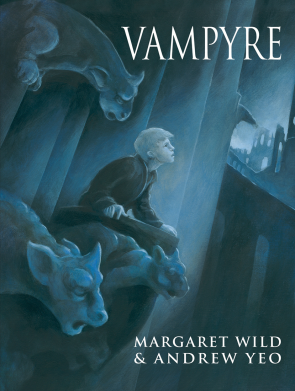
Vampyre, written by Margaret Wild and illustrated by Andrew Yeo, is a sensitive story told from the point of view of a vampire who is entering young adulthood with the responsibilities that come at that time in life. He longs for the life of innocence that he used to have and the communion he felt with nature and animals. Instead he faces hatred from villagers and he is regarded with fear. The book shows the struggle to be an individual and find your identity. Andrew Yeo’s illustrations effectively support the themes of the novel. The resource explores this book closely and invites students in the final Rich Assessment Task to consider the book against other books by Margaret Wild.
Introductory activities
The pre-reading activities below are designed to set the stage for the close study of the picture book. The first activity explores students’ relationships with picture books and why they value them. This will lead further on in the unit to a discussion on literary value and the power of the form to evoke a deep response through sophisticated and deliberate methods of representation. The second activity tunes students into the content of the picture book and draws attention to what they already know. This activity will lead to further discussions of intertextuality and elements of vampire literature and the gothic later in the unit.
The Synthesising Task is best conducted after Activity 3 (before commencing the Close Study).
Activity 1: picture books
This activity is designed to assess if, why and how students value picture books.
Ask each student to write down their five favourite picture books. In groups compare lists and decide on the top five books for the group. The teacher can draw a table on the board and collate the lists from each group to find the class’ top five books. The class may wish to vote on their favourites.
After this activity it is important to ask students to justify or evaluate their choices using the following questions. The questions may be used in a variety of ways. Individual students can choose one book from their lists and complete the questions. A group may complete these questions about their top three texts or the teacher may choose to model the questions and answers for the entire class.
- What is the book about?
- How did the book make you feel or think?
- What do you remember most about the book? Story, words or pictures?
- Why is it a great picture book?
- Who are picture books created for?
- Why do authors create picture books?
- Why might some people not like the book you have chosen?
- What indicates that this book is not a representation of reality?
Teachers can use students’ responses to the questions to provoke a discussion about the value of picture books and why they are important to study in class.
(AC9E7LA07) (AC9E7LE02) (AC9E7LE03) (AC9E7LE04)
Activity 2: genre
Start with a conversation about what students know about vampires. There are many texts concerned with this subject matter and students may or may not be familiar with them.
Ask students how they know this. What texts about vampires have they read or viewed?
Lists can be made of the rules and conventions of vampire stories; for example, what vampires can do and cannot do. List any examples of variations on the conventions. For students who require a more structured approach, provide a list of statements about vampires to agree or disagree with, such as:
- vampire stories are set in the future
- all vampires are men
- vampires don’t have feelings
- vampires have families
- vampires live in Transylvania
- vampires sleep in coffins
- vampires wear capes
They can use a graphic organiser (e.g. a Y- or X-chart) to write down their ideas.
- They should answer ‘Who? What? Where? When? Why? And how?’
- What do they expect in a book called Vampyre?
- What does the cover suggest?
Students could devise a list of expectations for a picture book about vampires to reflect on after a first reading.
Activity 3: understanding colour in artwork
Art is not just about reproducing what we see: it is about creating a mood and feeling around an object. Just like words and sentences, the arrangement of lines, colours and shapes will trigger a response. Through the use of colour, line and shape the artist is also able to convey personal, social and cultural values.
In order to discuss this, however, students will need to know the right language. Introduce the terms below and ask students to find definitions:
| monochrome | polychrome | hue | saturation | shade | contrast |
| tint | tinge | organic | abstract | texture | chiaroscuro |
| sepia | restricted palette | vector | perspective | tone | scale |
| salience | stylised | spectrum | realism |
Students can also consult a list of words to describe colours. They should find six words that they think apply to the colours in the cover image. They should explain the relationship of these colours to the title of the book.
Colour is emotion
What colour do you associate with these emotions? What shapes and lines do you associate with these emotions?
- Anger
- Sorrow
- Anxiety
- Happiness
- Excitement
Ask students to decide which colours would capture a vampire story. They need to justify their colour choice.
Colour is tone
- How has the illustrator represented this world of darkness?
- What are the three main colours in the book?
- The illustrator is working with a restricted palette to represent this world. This means that only the shapes of things are represented and not in their true colours, (e.g. trees and animals). Why does the illustrator do this?
Understanding tone
Rather than colours, the artist has used a wide range of tones.
Students can be assigned to different pages. They find the darkest and lightest colour. They can count how many different shades/tones of colour exist between these. What is the effect of using different tones instead of different colours?
Using Word, PowerPoint or a similar program, students draw ten boxes and apply a range of tones in one colour to each (see examples here). They can then apply emotions to each of the tones and present this to the class. This task is designed to show the range of tones avaiable and to test students’ skill with ICT.
(AC9E7LA07) (AC9E7LE03) (AC9E7LE04) (AC9E7LY04)
See the upcoming Synthesising Task for a more extended activity.
Personal response on reading the text
Roles and expectations
Discuss the following:
- Everybody has a role in life: to be a good parent or child; to protect others; to obey others; to enjoy life; to be responsible. What do you think is your role in life?
- How has your role changed from primary to high school?
- What are the extra expectations placed on you?
- How do you think your life will change after high school? What will be expected?
- What do you miss from primary age?
- What will you miss from childhood as you get older?
- What do you think are the roles and expectations of a vampire?
(AC9E7LE01) (AC9E7LY02) (AC9E7LY03)
Questions as you read the story
Discuss the following:
- What is the vampire’s role in life?
- In what way has the vampire’s life changed?
- How is he perceived by others?
- What sign is there that he doesn’t fit in?
- How does he change his life?
(AC9E7LE01) (AC9E7LE03) (AC9E7LE05) (AC9E7LY03)
Synthesising task
An artist’s justification
This task can be done in two ways: either students can submit their own original ideas for drawings based on the transcript, OR they can take the existing pages and use them as samples to explain to the author their vision of the book.
The illustrator has to work with the writer to convey what the writer wants.
Imagine you have been asked to draw images for a book called Vampyre. You need to submit a proposal to the writer of how you will visualise the words and offer sample pages.
- What questions do you need to ask the author before you can draw the images?
- What kinds of images would you expect to draw?
- What colours might you use?
- What do you think the setting might be?
You receive the transcript (PDF, 104KB) of the book. Choose three pages from the book or design your own three pages – write an explanation to the author of your vision for the book. Submit a plan to the author about how you will depict these pages and why you have made these decisions.
The writer and illustrator’s craft
Structure
Match specific pages with the following features of plot:
| Plot | Page numbers | |
| Exposition | ||
| Complication | ||
| Climax | ||
| Resolution |
The text starts with the present time, moves to a memory and then returns to the present. What is the book saying about identity and growing up through this structure?
Characterisation
Characters are revealed more by their actions and what they say, than by direct description. In a picture book there is the additional element of pictures to reinforce the characterisation. Any conclusions you draw about character are therefore reinforced by the evidence found in words or images.
Images depend on conventions such as composition. Composition, the placement of images on a page, is important. The rule of thirds is about imagining the page as divided into three vertical and three horizontal lines. Images are positioned in one of the imagined boxes formed. This suggests more about the character: if he or she is on the edges, we might say they live on the edges or margins – they could be outsiders or feel they don’t belong. In contrast, if the person is in the middle we see them as central to the action.
For this activity students have to storyboard (PDF, 126KB) the different pages showing roughly, with stick drawings, where the vampire is on each page. They can then draw conclusions about what the artist was trying to say about the character through the placement of the figure.
- How much space is on each page? Students can use their storyboards to shade in the area of space on each page.
- What is happening when there is a lot of space? Why is there so much space? What is this saying about the character and the ideas?
Complete this chart using your understanding of words and images to give evidence of the character.
| About the character | Words that show this | Images that show this | |
| He is unhappy | |||
| He used to be liked | |||
| He doesn’t like being an adult | |||
| He struggles with his identity | |||
| He doesn’t fit in | |||
| He is determined | |||
| He feels excluded and isolated |
(AC9E7LA07) (AC9E7LE02) (AC9E7LE03) (AC9E7LE05) (AC9E7LY03)
Setting
A typical Gothic setting might be a castle or a graveyard.
- What is the setting for this book? How does it fit into a Gothic theme?
- In what period of time do you think the story is set in?
- Are there any words that give hints of the setting (time and place)?
- What do the images convey about the setting?
- Consider the vampire in his setting – what relationship do we see between him and the different places he inhabits?
Use of parallels and contrasts
The book relies on contrasts to show how things have changed.
These contrasts are created from the opening page:
I live in darkness.
I long for light.
Note the structure of the two parallel sentences (‘I live in/I long for’) showing conflict of reality and desire.
Students should find any other contrasts and share these, deciding what the contrast is conveying. These contrasts include:
- verbs (past and present)
- time words
- images
- descriptions of animal reactions
- childhood/adulthood
- night/day
- above/below
- vampires/humans
They can represent this on a table.
Students should explain the effect of the verbal and visual language in showing conflict between what is desired and what is real.
(AC9E7LA04) (AC9E7LA07) (AC9E7LE05) (AC9E7LY03)
Point of view
Point of view is about whose eyes we see the story through. In this case it is clear that we are seeing the story through the point of view of the young vampire because of the first person narration.
The written text is spoken by the vampire – are we also seeing the images through the vampire’s eyes?
Students should change the narrator. They can be assigned a different character (the father, mother, brother, sister, villager or deer) and retell the story. They can then share the different versions. Is the story as effective? What is gained? What is lost?
(AC9E7LA07) (AC9E7LE02) (AC9E7LE05)
Written and visual language and style
Written language
There is simplicity in the storytelling. Short sentences declare intense feelings. But the language is also visual and this conveys mood and meaning as much as the words.
Students can trace the development of language through the text:
- Find prepositional phrases that are about place and time (these phrases start with prepositions – small ‘position’ words that give detail such as ‘in’, ‘on’, ‘for’, ‘by’, ‘above’, etc.). How important are these phrases for developing meaning?
- Look at participles. Find the -ing particles and the -ed participles. The -ing participle is often associated with constant movement and is called the continuous participle. The -ed participle is less open and suggests a complete action – it can be confused with the past tense. What is the effect of these participles in the text? What period of time do they describe?
- The book mostly uses the simple present verb tense – ‘I live’ (instead of ‘I am living’ – present continuous). Change all the simple present tense verbs to present continuous verbs – how does this affect the mood?
- Why is the line ‘I am Vampyre’ repeated?
- The short lines look like a poem – try to reproduce this as a poem. What changes did you need to make?
Visual language
Gargoyles are a repeated image. Why are they used? What do they represent? What feelings of the vampire do they reflect on different pages?
Just like films, picture books use the conventions of camera angle to convey meaning. A high angle (looking down on a character) suggests the character is worthless or submissive; a low angle (looking up at a character) will suggest that the character has power. A wide shot shows the character in the setting, a close up may focus on the emotions.
Students can return to the storyboard from earlier (under Characterisation). They can add information on the camera angles being used. They should also indicate the colours on each page. They can then interpret this and discuss what the effect of the camera angles is. How do the changing compositions, use of space, colour and camera angles capture the changing emotions of the boy?
Themes and ideas
Identity – nature or nurture?
One of the most argued debates about identity is about whether we are formed by nature or nurture – this means, are we born with all our characteristics/personality traits OR does the way we are brought up have the most influence?
Students discuss this in groups. They can list elements of their personalities that they share with other family members, and elements of their personality that are unique to them, to decide which is the most important influence. How important are people’s expectations in shaping your identity?
Exploring assumptions
Complete these sentences about everyday assumptions/sayings:
- If you grow up in violent household you will become …
- Everybody has the ability to …
- An apple doesn’t fall far from the …
- What happens to you is an accident of …
- Some people have the … to be a genius.
- Some people are … great; other have greatness thrust on them.
If students need clues then give them these words:
| change | birth | potential | violent | born | tree |
Ask students to decide if they agree or disagree with these statements. They can also add any sayings they know.
They can then Google quotations about nature/nurture. Some appear below. Students discuss if these quotations are supporting nature or nurture as the most powerful influence on individuals:
- ‘Man acquires at birth, through heredity, a biological constitution which we must consider fixed and unalterable, including the natural urges which are characteristic of the human species. In addition, during his lifetime, he acquires a cultural constitution which he adopts from society through communication and through many other types of influences. It is this cultural constitution which, with the passage of time, is subject to change and which determines to a very large extent the relationship between the individual and society.’ – Albert Einstein, ‘Why Socialism?‘, 1949
- ‘Man does not actually produce variability; he only intentionally exposes organs/beings to new conditions of life, and then nature acts on the organisation and causes variability.’ – Charles Darwin, On the Origin of Species, 1859
- ‘Give me a dozen healthy infants, well-formed, and my own specified world to bring them up in and I’ll guarantee to take any one at random and train him to become any type of specialist I might select … regardless of his talents, penchants, tendencies, abilities, vocations and race of his ancestors.’ – John Watson, Behaviourism, 1924
- ‘I am not what happened to me, I am what I choose to become.’ – Carl Jung (1875–1961)
- ‘I am not a product of my circumstances, I am a product of my decisions.’ – Stephen Covey (1932–2012)
- ‘Tabula rasa (The mind is blank slate).’ – John Locke, ‘An Essay Concerning Human Understanding’, 1689)
Which of these quotations is most relevant to the ideas in the book Vampyre? Explain your choice with evidence from the story.
Writing a thesis statement on the theme
When we discuss books we state a theme as a thesis statement. Students have to design a thesis statement on the book Vampyre about the topic of ‘nature versus nurture’. If students need support then ask them to tick which of the statements below might best describe the book. Alternatively, give students these thesis statements as sentence starters so that they complete what they believe.
- The book tells us that everyone has the ability to change their lives.
- In Vampyre, identity is a struggle for many people who do not fit conveniently into their allotted slot.
- Vampyre shows us that we can’t choose who we are and have to accept our lives.
- Family is the most powerful influence on our identity, according to the book Vampyre.
- Identity is an individual thing that can often go against our upbringing, as we see in Vampyre.
Synthesising task
Experimenting with story
Here are three different ways of rewriting the story. Students will experiment with the story to see how differently the same narrative can be structured and presented. In so doing, they will come to an understanding of narrative structure. The earlier Point of View activity can be part of this experiment.
- Rewrite the story in a different order, starting from the vampire’s childhood OR starting from his being in the woods at the end (add flashback). Does it have the same impact?
- Extend the story into a narrative of 500 or more words. What features will you develop? Think about how detail can be added: descriptions, dialogue, a symbol, more events.
- Write the story of the next generation. How would this gentle vampire’s son feel when he is not allowed to be vampire?
Ways of reading the text
Gothic
The Gothic is a genre of popular literature that emerged in the 18th century. It centres on fear and the duality of good and evil. This fear can be associated with death; it can also be about the struggle of inner ‘demons’. Modern interpretations of the Gothic often show good struggling to overcome evil. The usually evil characters are seen to have sensitivity and awareness of their goodness.
Students can conduct research and complete the table below on typical features of the Gothic.
| Setting | |
| Characters | |
| Plot | |
| Themes |
Context: vampires
Vampires have held a fascination for many centuries. The origins of the vampire story seem to be from early 18th century southeast Europe. The period of Romanticism in the late 18th to early 19th century was a time when many European folk stories were discovered and spread to the world. It’s from that period that dark stories such as Little Red Riding Hood come, with fear being the significant emotion.
The 19th century saw the writing of famous stories such as The Vampyre by John William Polidori (1819) and Dracula by Bram Stoker (1897). Stoker based his story on a book of essays called Transylvanian Superstitions (Emily Gerard, 1885). His character Dracula was based on a real person: Vlad III the Prince of Wallachia, also known as Vlad the Impaler for his barbaric practices towards his enemies. Not all stories about vampires cast them as evil; Stephenie Meyer’s Twilight Saga gives a human face to vampires.
Why do you think Margaret Wild chose to use Polidori’s spelling of the word ‘vampyre’ for her title?
Vampires in popular culture
What aspects of vampires do the following Simpsons clips reveal? How is the humour created?
Rewrite the story of Vampyre with a humorous twist.
(AC9E7LE03) (AC9E7LE04) (AC9E7LE05) (AC9E7LE07) (AC9E7LY03) (AC9E7LY06)
Australian Gothic YA fiction: wide reading
Gerry Turcotte writes:
Long before the fact of Australia was ever confirmed by explorers and cartographers it had already been imagined as a grotesque space, a land peopled by monsters. The idea of its existence was disputed, was even heretical for a time, and with the advent of the transportation of convicts its darkness seemed confirmed. The Antipodes was a world of reversals, the dark subconscious of Britain. It was, for all intents and purposes, Gothic par excellence, the dungeon of the world. It is perhaps for this reason that the Gothic as a mode has been a consistent presence in Australia since European settlement. Certainly the fact that settlement began in the eighteenth and nineteenth centuries, during the rise of the Gothic as a sensationalist and resonantly influential form, contributes to its impact on the literature of Australia.
– Turcotte, G. (1998). Australian Gothic (Version 1). University of Wollongong.
This is a difficult reading and may need some unpacking, but it will allow differentiation for students who need extending. It adds a required depth for critical thinking. Ask students if they agree with Turcotte.
Australian Gothic is an interesting area of study. Australia is not the usual place for vampires but every place has a dark side. There are many Australian writers of Gothic novels who try to show that the dark side of humanity exists in unexpected places:
- Victor Kelleher wrote his version of the vampire story in the book Into the Dark from the point of view of Dracula’s servant.
- Kim Wilkins’ books on Gina Champion explore the problems of being a witch in modern day society.
Other Australian gothic novels for young audiences include:
- The Devil Latch by Sonya Hartnett
- Sabriel by Garth Nix
- Gothic Hospital by Gary Crew
- Dreaming of Amelia by Jaclyn Moriarty
- In the Blood by Jackie French
- Afterworlds by Scott Westerfeld
Students can form literature circles, reading and discussing Australian Gothic stories. This activity will form the foundation of the next Rich Assessment Task.
Rich assessment task (productive mode)
Design a pamphlet on the Australian Gothic
This assessment can be part of a wide reading task with students reading different Australian Gothic novels. They then share their knowledge.
The task
You are a graphic designer. Write an information pamphlet called ‘Facts about vampires and their Australian world’. You can use information from Vampyre and add any other knowledge you need. You can think of places in your suburb that you can recreate as Gothic.
Alternative task (increased difficulty)
You are a graphic designer. You have been asked by a travel agent to design a pamphlet for people wanting to do a literary tour of Australian Gothic landscapes. You will need to include Margaret Wild’s book and any other literary sources you have read. This may include:
- The Devil Latch by Sonya Hartnett
- Sabriel by Garth Nix
- Gothic Hospital by Gary Crew
- Dreaming of Amelia by Jaclyn Moriarty
- In the Blood by Jackie French
- Afterworlds by Scott Westerfeld
- other books, in consultation with your teacher
Study of an author and her work: Margaret Wild
Margaret Wild is a significant Australian children’s writer. Her books are very popular and capture a wide range of ideas for children and young adults. Wild’s subject matter is varied and her style alters to suit the context of the characters and the ideas she wants to convey; however, like all authors, she returns to the same thematic concerns again and again. In this section of the unit, students will be required to search for the ideas that link her work.
Research
Research the work of Margaret Wild.
- What books has she written?
- What awards has she received?
- What is the usual age of her audience? What other audiences has she written for?
- Read some reviews and find a couple of comments about her work.
Wide reading
Students can work in groups to read the following picture books for young adult audiences by Margaret Wild:
- Woolvs in the Sitee illus. Anne Spudvilas
- The Dream of the Thylacine illus. Ron Brooks
- Fox* illus. Ron Brooks
They can use the comparison chart (PDF, 110KB) to map their notes about each book.
Points of similarity
| Titles | Predatory animals feature in the titles; vampires are also predatory. |
| Settings | The settings are Australian (urban, zoo or wilderness places) except for Vampyre. |
| Characters | The main characters are outsiders, struggling with their identity. |
Points of difference
| Language | The book that stands out grammatically is Woolvs in the Sitee because of its phonetic spelling, capturing the main character’s lack of formal education. The Dream of the Thylacine has some old-fashioned phrases. Vampyre also has a slightly stilted phrasing. These three books are in the first person from the protagonists’ point of view, whereas Fox is in the third person, usually focalised through the magpie.
Why has Wild used such different language in each of her books? |
| Artwork |
Ask students to explain why the artwork is so different for each book |
| The artists | Students should find their favourite image in each book and share it with the class, explaining why they liked it.
Wild has worked with three different visual artists for these books: Ron Brooks, Anne Spudvilas and Andrew Yeo. Which artist do students like best and why? Writers and artists work together to create a text that we can read and enjoy. Ask students what would happen if the artists did a different book with Margaret Wild. For example: would Ron Brooks’ style have worked with Vampyre? Would Anna Spudvilas’ style have worked with Fox? Would Yeo’s style have worked with Fox or The Dream of the Thylacine? |
More picture books for older readers by Margaret Wild
- The Feather* illus. Freya Blackwood
- The Treasure Box* illus. Freya Blackwood
- The Stone Lion illus. Ritva Voutila
- Girl from the Sea illus. Jane Tanner
- Tanglewood illus. Vivienne Goodman
- Jenny Angel illus. Anne Spudvilas
* Reading Australia title
Rich assessment taskS (receptive mode)
The culminating task for this unit can be either an imagined interview with Margaret Wild (spoken presentation) OR a comparative essay (written). The focus is on Wild’s body of work – not just Vampyre. The main question is:
What is it that characterises the work of Margaret Wild?
Option 1
Spoken task: an interview with Margaret Wild
Imagine that you are the host of ABC RN’s The Book Show (or a similar program/podcast). You have to record a podcast interview with Margaret Wild. The purpose of the interview is to focus on the picture books she has written for young adult audiences and answer the question about what characterises her body of work. Your discussion should include a consideration of her audience (why is she targeting teenagers with picture books?); her ideas; her style; her themes; and her work with artists.
NOTE: This task can be done in pairs, with one student taking on the role of the interviewer and the other the role of the author. Alternatively, students can work individually and record both parts of the interview.
(AC9E7LA02) (AC9E7LE03) (AC9E7LE04) (AC9E7LE05) (AC9E7LY02)
Option 2
Written task: a comparative essay
Choose ONE of the picture books to compare to Vampyre and come to an understanding of what it is that characterises Wild’s work.
You may use the notes from the comparison chart to guide you.
(AC9E7LA02) (AC9E7LA04) (AC9E7LE02) (AC9E7LE03) (AC9E7LE04) (AC9E7LE05) (AC9E7LY06)