Connecting to prior knowledge
Before reading
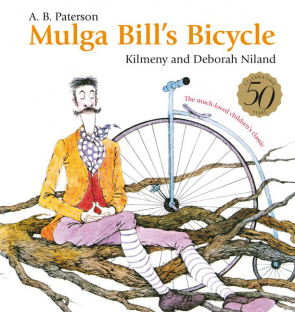
Show students the cover of Mulga Bill’s Bicycle and ask them to think-pair-share regarding their predictions about the book. They can record their predictions, and the reasons for these, on the provided worksheet (PDF, 90KB).
Reading the text
Tell the students that you are going to read the story the whole way through. Explain that, while there may be unfamiliar words, you want them to listen and look at the pictures to see if they understand what happens. Then read the text in its entirety, with rhythm and emphasis (see this video for a good example).
Ask pairs or small groups of students to answer the following questions to ensure they have the gist of the story:
- What happened at the beginning of the story? (e.g. Mulga Bill bought a bicycle)
- What was the problem/complication in the story? (e.g. He didn’t know how to ride a bike)
- What happened because of the problem? (e.g. He crashed/landed in the water)
- How did the story end? How was the problem solved? (e.g. He left the bike in the water and went back to riding his horse)
- Refer back to the predictions worksheet. Were your predictions right?
As a class, discuss and record some answers to revisit in later lessons.
Exploring the text in context of our community, school and ‘me’
A closer reading for setting (context of time and place)
Ask students to share their predictions about when this story may have happened, and if this is different to what they initially thought when looking at the cover.
Indicate that the poem was written by A.B. ‘Banjo’ Paterson in 1896. Point out and share some of the information in the back of the book, including when the illustrations were created.
Use the front cover and first few pages to model looking for clues that tell us when this story happened. Record them in a table like so:
| Clues in the words | Clues in the pictures |
| The words ‘children’s classic’ on the cover
Mulga Bill has a ‘good old horse’ |
The type of bike on the front cover
Mulga Bill’s cycling clothes |
Continue working through the book, with students joining in to identify clues in the words and pictures.
Repeat this process to look for clues that tell us where this story happened.
Rich assessment task
Guide students to think about the connections they can make to the story. What is similar and what is different to their own experiences? Use questions such as:
- What sort of things do you ride on or in?
- Where do you ride?
- What is the new ‘craze’ now?
- What experiences have you had learning to ride or do something new?
Have students record their personal connections. This could be done using a Venn Diagram (PDF, 78KB).
Responding to the text
Comparing opinions about events
Read Mulga Bill’s Bicycle to students again, asking them to identify parts that make them feel an emotion (e.g. happy, sad, excited, angry, relaxed, frightened, worried). Students could be asked to re-enact some of the events in the story.
Think-pair-share and then ask students to record their responses to three to five parts of the story. They could do this on a plot graph (PDF, 93KB).
Have students form groups to discuss the similarities and differences in their feelings towards different parts of the story. Each group should report back to the class based on their discussion. As they do so, try to capture a whole-class record of emotional responses. For example, keep a tally of the feelings students describe at different points in the story.
Exploring plot, character, setting and theme
Inferring character’s feelings
Explain that you will now investigate Mulga Bill’s feelings and how they change in different parts of the story. Students will be looking for clues in the words and illustrations again.
Using the first events identified on the plot graph (see above), model how to name Mulga Bill’s feelings and identify clues in the words and illustrations. Record these in a table (PDF, 98KB). Children could draw or mime Mulga Bill to show his emotions at a particular point in the story.
Continue working through the book, jointly completing the table with students. Alternatively, assign different events to small groups of students and have them report back to the whole class.
Thinking about entertaining texts
Explain that the poem ‘Mulga Bill’s Bicycle’ is a special kind of text called a ballad (a poem that tells a story), and that two illustrators drew pictures to make it into a picture book.
Ask students to help you list the features of literary texts that make them entertaining. For example:
| Picture books | Pictures help us see and feel what is happening
Can be beautiful, colourful, funny |
| Narratives | Funny, exciting or scary things happen
Interesting or funny characters Words that help us see and feel what is happening |
| Poems | Rhyming helps us predict and is fun
Rhythm fast or slow to match what’s happening The sounds of the words: hard or soft, or lovely to hear and say |
Rich assessment task
Model how to write about personal preference by showing students Work Sample 2 from the following portfolios:
Jointly deconstruct the samples to make the structure and language features clear.
Take an event from Mulga Bill’s Bicycle and model how to identify and record aspects of the text that the author/illustrators have used to make it entertaining. You can use the provided table (PDF, 87KB) as a guide. Finish by modelling how to use the information from the table to give an oral presentation.
Ask each student to choose their favourite event from the book, prepare their own table and give an oral presentation.
Examining text structure and organisation
Rhyme
Revise the concept of rhyme (e.g. rhyming words and rhyme scheme). Make it clear that rhyming words have the same ending sound, but may not end in the same letters (e.g. craze/days, seen/machine). Links could be made here to spelling.
Provide each student with a copy of Paterson’s poem (consider laminating these so the students can annotate with whiteboard markers). Have students identify and highlight the rhyming words at end of each line. If you have not already done so, explain what a rhyming couplet is. Then ask students to identify the rhyming couplets in the poem.
Rhythm
Introduce students to the idea of rhythm as the beat of the poem. Practise hearing and clapping the beat of familiar songs, chants and rhymes.
Remind students that ‘Mulga Bill’s Bicycle’ is a ballad. If you have not already done so, explore some of the features of ballads. Then have the students identify and clap the beats as you read the first four lines of ‘Mulga Bill’s Bicycle’. Once they can clap the rhythm, display the poem and ask them to clap and chant the opening two lines. For each clap, place a marker above the stressed word/syllable. Ask students to mark these on their own copy of the poem and count the beats per line. For this poem, there should be seven stressed beats per line (i.e. ‘Twas Mulga Bill, from Eaglehawk, that caught the cycling craze‘). Have half the class chant the next two lines while others mark the beats, then swap for the next two lines. Students could continue to identify beats working in pairs or small groups.
Practise choral chanting/reading the poem aloud. This could be accompanied by students acting out the story.
Examining grammar and vocabulary
With students, generate a list of 10–20 unfamiliar words from the poem and record these in a table (PDF, 85KB).
Re-read the book, stopping when the unfamiliar words are used. Model/jointly construct how to:
- Use prior knowledge, contextual clues and connections to known words to ‘guess’ a word’s meaning
- Test and check the meaning
Assign three to four words to pairs of student to complete this process. Have them share their findings with whole class.
Rich assessment task
Have students create rhyming couplets or short poems about bikes, skateboards or scooters.
As an optional extension, experiment with changing some of the rhymes in Mulga Bill’s Bicycle. For example:
| ‘cycling clothes, resplendent to be seen’ | Change to ‘cycling clothes, of red and blue and green’ |
| ‘that sought his own abode’ | Change to ‘that headed for his shack’ and have students think of a rhyming word to finish the next line (e.g. ‘beside the mountain track‘) |
| ‘Dead Man’s Creek’ | This phrase appears in two rhyming couplets; have students brainstorm a different phrase that ends with a rhyme for ‘streak/shriek’, and replace it in each couplet (e.g. ‘Big Bird’s Beak’) |
Narrative structure
Review the structure of a narrative and map the story of Mulga Bill’s Bicycle using some guiding questions (PDF, 91KB).
Share some other books about learning a new skill for shared, guided and independent reading. The Wobbly Bike by Darren McCallum, illustrated by Craig Smith, or Over or Under?* by Pip Harry, illustrated by Hilary Jean Tapper, are good options. Students should identify the parts of the narrative and answer the guiding questions for these books, as outlined in the handout.
* Reading Australia title
Planning and jointly constructing a narrative
Explain the upcoming Rich Assessment Task to students, stating that you will practise writing a modern-day narrative as a class before they write their own. Tell them that you will plan your narrative together in steps; after each step, students will work on the plan for their own story.
Before you begin, briefly revise the aspects of a narrative that make it entertaining (Responding > Exploring Plot, Character, Setting and Theme > Thinking About Entertaining Texts). Then, referring back to the Rich Assessment Task from the Literature section, brainstorm new crazes or new skills to learn. As a class, choose which craze your character will get caught up in, or the new skill they will try to learn.
Create a plan for the class story by completing the guiding questions (see handout above). After each part (orientation, complication, events, resolution), have students follow the same process to develop their individual story plans. Choose no more than three or four events for each story. When considering these, further questions could be asked to help students reflect on Mulga Bill’s Bicycle and adapt the events to a modern-day setting. For example, if the class story is happening near your school:
- What could the main character nearly run into?
- What could they frighten away?
- Where could they land?
With the list of entertaining narrative aspects and the class plan displayed for easy reference, jointly construct the class story, modelling the writing process using think-alouds/focused questions to show author choice. If desired, you could also model the use of Book Creator or a similar platform/app to create the story, including visuals.
Rich assessment task
Using their plans from the previous activity, students are to innovate on the story of Mulga Bill’s Bicycle to create their own modern-day narrative about catching a new craze or learning a new skill (e.g. riding a bike, learning to swim). Encourage students to consult their plans and carefully draft and edit their work.
Work with students to develop assessment criteria or a rubric for this task. This may include:
- Evidence of the different parts of a narrative (orientation, complication, events, resolution)
- Use of the entertaining aspects of a narrative
- Other grammar work you may have covered (e.g. writing in complete sentences with punctuation, descriptive noun groups/phrases, etc.)
You might have students use the agreed upon criteria/rubric to give peer feedback before they finalise the stories.