Content warning
Tiger Daughter addresses themes of domestic and family violence and suicide. It is essential that you understand what connections (if any) your students have with these experiences before you select this text for study. Approach these topics sensitively and consider working with another member of staff (e.g. school psychologist, student services coordinator) to ensure that all students feel safe and supported throughout this unit.
Introductory activities
Rebecca Lim is passionate about intersectionality and diverse representation in children’s and young adult literature. Her adolescent novel Tiger Daughter follows a kind and determined Chinese-Australian girl who dreams of making a better life for herself.
Wen Zhou is the only child of Chinese immigrants. Her father is an intelligent but frustrated man who tends to lash out at his wife and daughter. At the start of the novel, Wen and her friend Henry Xiao are preparing to sit an entrance exam for a selective high school – until Henry’s family is rocked by a tragedy. Wen goes to great lengths to support her friend, including breaking her father’s rules. This inspires her mother to find her own strength and explore life beyond the confines of their family home. Tiger Daughter demonstrates the importance of friendship and community, with characters from different backgrounds and circumstances doing their best to help one another and do the right thing – even when it is difficult to do so.
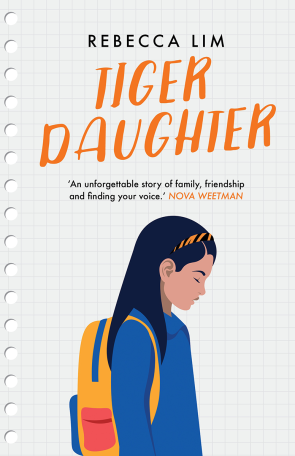
Show students the front cover of Tiger Daughter and draw attention to the title. As a pre-reading activity, they can look up the qualities ascribed to the Tiger in the Chinese Zodiac and answer the following questions:
- What are the dominant characteristics of this sign?
- What do you think the protagonist of Tiger Daughter might be like?
- Write down three of your predictions for this novel.
The author’s notes
Read the Author’s Note (pp. 209–210) and Note to Teachers and Librarians (pp. 211–214) at the back of the book. Exploring Lim’s intentions, and examining the novel’s representation of diversity and migrant cultures in Australia, enables students to develop an understanding of realist fiction and its role in exploring and questioning the world around us.
Lim has been very purposeful in her construction of Tiger Daughter and makes clear that it is the result of many years of reflection. She also acknowledges the importance of her own identity as an Asian-Australian woman, and how her experiences growing up have informed the novel.
Ask students:
- What repeated themes and/or ideas emerge from Lim’s notes?
- What is the ultimate goal or project of her novel?
Broader questions that could form the basis of inquiry and discussion include:
- Why do we need books to represent social realities?
- How can novels change, challenge, or inform readers’ thoughts and values?
A provocative question for class debate could be:
Can writing be a form of social commentary, or should the primary focus of literature be to create art? Can it ever be both?
Students may express a variety of opinions here. If you use Google Classroom and want to encourage everyone to contribute to the debate, you could set up a question so that students can reply to it and each other.
Background to the text
Geography
Lim’s story takes place in outer suburbia, far from the city centre (references suggest that the characters live on the outskirts of Melbourne). Readers get the sense that, at least for Wen, the city exists as a type of dream or mirage: aspirational, but ultimately unattainable. The unnamed suburb she lives in has a reputation for crime and violence; she cannot even go to and from school, ‘the safest place’ in her life, without parental supervision (p. 7).
Students can read this 2013 Conversation article and this 2021 Guardian article, or you can provide them with appropriate excerpts (this 2026 ABC News article would also be appropriate). First ask:
- What does the Conversation article say about ‘snobbery’ and some of the infrastructure issues in Melbourne’s outer suburbs?
- What does the Guardian article reveal about some of the problems in areas outside major capital cities?
Then discuss as a class:
- Why do you think there tends to be a higher migrant population in outer suburbs (this 2018 Conversation article may be useful here)?
- Why might Lim wish to portray this environment in her novel?
Students may also wish to investigate the cultural diversity of their own communities. They can use the SBS Australian Census Explorer to explore suburbs of interest. Do any of the statistics surprise them?
History
Chinese migration to Australia began much earlier than the wave portrayed in Tiger Daughter. The LOTE Agency and Sydney Theatre Company offer some useful timelines, while the Origins and Multicultural and Multifaith Victoria websites outline Chinese migration to Victoria specifically. You might like to share excerpts from the National Archives’ Chinese-Australian Journeys research guide, which traces more than 100 years of Chinese-Australian travel, migration, and settlement. You can also explore individual scenes from the Harvest of Endurance scroll, a 50-metre-long scroll depicting two centuries of Chinese contact with and migration to Australia.
Many of these resources mention the White Australia policy, which was legislated in 1901 and dismantled between the 1960s and 1970s. The policy was designed to not only limit non-British (i.e. non-white) migration to Australia, but also to deport ‘undesirable’ migrants who were already in the country. Students should consider how this policy has influenced ideas about who is allowed to belong, who is the ‘right’ kind of migrant, and who can call themselves a ‘real Australian’.
It might be interesting to explore some of the images from the Immigration Photographic Archive (you will need to ‘View digital copy’ once the item loads). Many of these photographs were taken specifically to demonstrate how migrants were integrating into Australian society. Prompt students to think about the following:
- When were the photographs taken? What was Australia’s immigration policy at that time?
- Where have the migrants mostly come from? Who is absent or underrepresented?
- What view of migrants do the photographs reflect? What story are they trying to tell?
This will help students reflect on the constructed nature of Australian society; the ongoing impact of colonial ideas and attitudes about race; and the systemic over- and under-privileging of different groups of people.
Optional extension
By now, students should be realising why Lim is so interested in expanding the notion of what ‘an Australian’ can be, and why she expressly set out to insert a non-traditional, non-mainstream Australian story into the body of published children’s literature.
As an optional extension, have students consider this 2015 Conversation article (noting that it is now more than 10 years old). The author prefers the adjective ‘multicultural’ over the noun ‘multiculturalism’ to describe the way diverse groups of people live, work, and play together in Australia. Ask students:
- What sort of things does the author suggest ‘we need to do’ and why?
- In what ways is Australia a successful multicultural society? In what ways could we improve?
- How can literature contribute to a positive social message around the value of a multicultural society?
Personal response on reading the text
One way to help students anticipate and prepare to engage with the ideas in Tiger Daughter is to present scenarios that orient the reader and connect to their life. Below are three scenarios that explore some of the issues raised at the start of the novel. You can use one or both of the following approaches:
- Students can work in pairs or small groups to create a poster or mind map that responds to one of the scenarios. They will present their point of view to the rest of the class as the basis for a whole-group discussion.
- Students can complete a jigsaw-style activity in which they respond to one of the scenarios, then group up with students who addressed the other two scenarios, and explore the different responses in detail.
Scenario A
A girl whose family immigrated to Australia sits in class, quietly appreciating the diverse nature of her new school. She is keen to help a fellow student with his English, and they both dream of attending a more prestigious school that will afford them better opportunities. By contrast, her father distrusts ‘people who aren’t like us’ (p. 20) and resents the fact that Australia has not been a land of opportunity for him. The girl’s mother rarely goes out and is unemployed.
- Why might some people find it hard to engage with a new community and/or in a new country?
- What sort of things could help this family feel more connected to the people around them?
Scenario B
An intelligent boy finds it difficult to communicate in English, which is not his first language. His classmates often laugh at his overly formal way of speaking. He ‘hardly ever has any lunch’ (p. 4) and his closest friend suspects that he isn’t well cared for at home. One of the boy’s teachers arranges for him to have lunch and encourages him to sit the entrance exam for a better school.
- What are some of the boy’s strengths?
- What are some of the challenges he faces?
- What is your reaction to his situation? How could you, as a fellow student, help?
Scenario C
A group of children live far away from the city, in a community that is stereotyped for its ‘homeless people, drug deals and gang violence’ (p. 7). Their favourite teacher only moved to the area because she had to care for a family member. Some students come from migrant or refugee families. Most don’t believe that they will ever be able to go anywhere else. A new teacher runs a catch-up class for students who are learning English; his students wonder if he really cares about them, or if they are just a ‘stepping-stone’ (p. 10) on his way to teaching at a wealthy private school.
- What are some of the barriers these children are facing?
- What sort of social justice issues are referenced?
- Does this scenario reinforce or challenge traditional views of Australian society?
Outline of key elements of the text
The dedication
Ask students:
What is a dedication and why would an author write one?
Lim’s dedication can be found after the title and imprint pages. Read it and discuss:
- What does this dedication suggest about Lim’s own life?
- What does it suggest about families?
- What kind of story might follow this dedication?
The prologue
Ask students:
What is a prologue and what is its purpose?
Read the Prologue to Tiger Daughter (pp. 1–11) as a class. Then, in groups, students can discuss their expectations for the novel based on what they have read.
- Who is telling the story (narrative voice, point of view)?
- What do we learn about Wen and Henry in the Prologue (e.g. their circumstances, their aspirations)?
- Note the title of the Prologue: ‘The day before things were never the same again’. What does this suggest will happen in the book?
The Analects
Tiger Daughter is divided into Part 1 (pp. 15–87) and Part 2 (pp. 91–206), bookended by the Prologue and a Coda (p. 207). Parts 1 and 2 begin with quotes from The Analects by Confucius, a Chinese philosopher and teacher who lived from 551–479 BCE. Use the following resources to introduce students to Confucius and his teachings:
Once students grasp the importance of Confucius to Chinese philosophy and culture, examine the quotes on pp. 13 and 89 of Tiger Daughter. What behaviour or value is each quote encouraging? How might it relate to that part of the story? Point out that the two quotes on p. 89 are contradictory – how can you be both compliant and a ground breaker? What might Lim want to say about The Analects by placing these quotes together? Students can discuss in pairs, groups, or as a whole class.
Note that Lim has also included a quote for the Coda. Unlike the others, this one comes from the Tao Te Ching by Lao Tzu, a founding figure of Daoism. Daoism and Confucianism, along with Buddhism, are considered the ‘three pillars’ of ancient Chinese society. Consider why Lim may have chosen to finish with a quote from Lao Tzu rather than Confucius (see pp. 52–53 for further context), and why this particular quote is a fitting end to the narrative.
There is also an opportunity here to discuss proverbs and wise sayings more generally. You could brainstorm sources of wisdom from other cultures, philosophies, and religions, and invite students to suggest some sayings they may know. Also discuss why humans might follow such sayings.
The setting
The goal of realist fiction is to achieve verisimilitude: to create a world that seems real to the reader. Some ways to achieve verisimilitude include:
- Providing recognisable details about the setting (time and place)
- Using recognisable and appropriate language (including idiom or colloquial language) for the narrator’s context and background
- Constructing realistic and plausible situations and characters
Have students consider Tiger Daughter’s Prologue, which includes a description of the ‘English Enrichment’ class led by new teacher Mr Cornish. Here we get a sense of the other students, the suburb they live in, and Wen and Henry’s home lives. Ask students:
- What assumptions can you make about the setting based on the Prologue?
- What details have been included and what details have been left out?
- Do you think Wen and Henry’s assumptions about Mr Cornish (pp. 10–11) are fair, or do they reflect her own feelings of isolation and discomfort?
Synthesising tasks
Imaginative writing
Ask students to imagine and compose a short piece of writing from Mr Cornish’s perspective directly following the Prologue. Encourage them to think about:
- Who or what he notices at school
- What he might do or think about after Wen and Henry leave his class
- How his perspective might differ from that of his students (and whether Wen and Henry’s assumptions about him are accurate)
Informative writing
The Prologue begins with Mr Cornish asking his students to write at least a hundred words in response to the question:
What is the essence of being ‘Australian’?
Have students write their own responses to this question. They should follow Mr Cornish’s instructions by writing in complete sentences – no bullet points!
Tiger Daughter lends itself to the discussion of several important social issues. Be sure to balance this with a consideration of the text’s literary value. Activities should encourage students to consider Lim’s language use, style, and manipulation of genre and structure, as well as the text’s wider cultural value as a work of Australian teenage fiction that portrays realistic people and situations in a culturally diverse society.
Structure and chapter titles
If necessary, revise the common elements of narrative structure. Also discuss what a coda is if you have not already done so. Then ask students to examine the chapter titles in Tiger Daughter and discuss how the story might progress. Which chapters might represent a complication, a climax, or a resolution? The book’s contents are listed below for convenience.
| Prologue | The day before things were never the same again (pp. 1–11) |
| Part 1 | Chapter 1: Small misfortunes (pp. 15–26)
Chapter 2: Bad news has wings (pp. 27–47) Chapter 3: Not do, not die (Bù zuò, bù sĭ) (pp. 48–63) Chapter 4: Common people (pp. 64–75) Chapter 5: One step, one footprint (Yībù yīgè jiăoyìn) (pp. 76–87) |
| Part 2 | Chapter 6: The Right Path (pp. 91–105)
Chapter 7: Eight dishes for luck (pp. 106–124) Chapter 8: Something from nothing (pp. 125–142) Chapter 9: Danger (pp. 143–162) Chapter 10: Everything changes (Yīqiè dōu găibiàn) (pp. 163–179) Chapter 11: Leaving, and returning (pp. 180–206) |
| Coda | (p. 207) |
Once students have read the whole novel, you could discuss the ending. Why might Lim have chosen not to reveal the result of the entrance exam? Would students have preferred to know the outcome, or is the ending satisfying in itself?
Characterisation
Readers can learn a lot about characters, including (but not limited to):
- What they look like
- What they say and do
- What they think and feel
- What others say about them
- What they say about others
Direct students to look closely at how Lim introduces her characters. What does she tell us about their personalities, beliefs, and attitudes?
Wen’s narration
Remind students that Tiger Daughter is focalised through Wen; readers experience the events of the novel as she does. Students could look at examples of Wen’s narration and consider:
- What they learn about her character
- What they learn about the world she has grown up in
- What experiences have led her to form her opinions
- Whether there are any biases in the way she views things
Working in pairs, groups, or as a whole class, students can locate and discuss the following quotes from Wen:
| ‘I know she had one job really, to have a son, and she managed to stuff even that up.’ (p. 24) | Why doesn’t Wen question the value behind this statement? Do you think she is expressing her own view here or reflecting something else? |
| ‘I’m impervious to improvement, I tell Henry, loftily, all the time. That’s a fancy way of saying I am resistant to mathematical theory in any shape or form.’ (p. 27) | Why do you think Wen is ‘resistant’ to maths? How does it demonstrate her evolving sense of identity?
Note the references to Wen’s parents (particularly her father) before and after this quote. |
| ‘… fury is like this thing that holds the entire house up … all of us are suspended like hot-air balloons and drifting further and further away from each other, and from our true selves.’ (p. 31) | How do these statements reflect Wen’s feelings about her family? What do the images created by the similes tell you about her home life? |
| ‘I know it’s over the top. I can’t help it. … dreams, just like food, can keep you alive.’ (p. 41) | Read the entire paragraph around this quote. What does it tell you about Wen’s character and her relationship with Henry?
Consider how this quote differs from Wen’s earlier statements about dreams (pp. 33–34, 38). Is this just for Henry’s benefit, or is it important for her too? |
| ‘Immaculate, just the way Dad likes her to dress, even when he can’t see her … She represents him, you see, at all times.’ (p. 41) | What does this statement reveal about the relationship between Wen’s parents? What does it tell us about the way she herself views them? |
Jin and Teresa Zhou
Wen’s parents, Jin and Teresa (Mei Ling), are important characters who change significantly over the course of the novel. Teresa’s development is more consistent, but Jin’s transformation is more dramatic. Students can trace their respective character arcs from chapter to chapter. At what point does Jin decide to relax his authoritarian stance? What sequence of events helps Teresa reconnect with her inner strength? You might like to provide the following roadmap to help students locate these important moments:
| Important chapters for Jin | Important chapters for Teresa | Important chapters for both |
| Chapter 9 (pp. 143–162) | Chapter 3 (pp. 48–63)
Chapter 4 (pp. 64–75) Chapter 8 (pp. 125–142) Chapter 10 (pp. 163–179) |
Chapter 5 (pp. 76–87)
Chapter 7 (pp. 106–124) Chapter 11 (pp. 180–206) |
Wen and Henry
Consider Henry and Wen as foils for one another. They come from similar backgrounds and have similar home lives, but there are also some key differences between them. Henry is good at maths, science, and IT, while Wen excels at art, athletics, and humanities. Henry envisions a grand future for himself, while Wen tries not to get her hopes up. Wen is supposed to be helping Henry with his English, and he with her maths. More importantly, however, Wen offers Henry a vital point of connection when he wants to shut out the world, and Henry helps Wen realise that she is both capable and deserving of pursuing her own dreams.
Students can write an analytical paragraph comparing Wen and Henry. Encourage them to consider the following:
- How are Wen and Henry’s circumstances similar as the only children of immigrant parents?
- What are their unique strengths and outlooks?
- What are their challenges and vulnerabilities? Consider Henry’s status as a relatively new arrival in Australia (racism), and the expectations and opportunities for Wen as a daughter (sexism).
Fay Xiao
NOTE: It is impossible to talk about Henry’s mother without discussing suicide. This is a complex and highly sensitive issue; not all of the characters in Tiger Daughter understand or are sympathetic towards Fay. Begin with a content warning so that students know what to expect, and remind them of the services they can access – including Kids Helpline (1800 55 1800) and Headspace (1800 650 890) – if these issues bring up anything for them.
Fay Xiao is never directly seen in Tiger Daughter, but – as Miss Spencer comments on p. 39 – she has everything to do with how the story unfolds. The narrative perspective limits our ability to fully comprehend her mental state, as Wen knows very little about Henry’s mother or her circumstances. Through carefully selected information, however, Lim paints a portrait of a woman who is completely overwhelmed, isolated, and unfairly judged by the people around her – both in life and in death.
Explore the discourses (i.e. ideas, values, attitudes) that influence the way people talk about Fay in the novel. If appropriate, you could explore some of the myths and misconceptions people may have about suicide. Then focus on some examples from the text:
| ‘Mum says it’s widely known, and talked about, what a bad mother Fay Xiao is.’ (p. 30) | Why might people assume that Fay is a ‘bad mother’? Is it fair for them to judge her without understanding what she is going through? |
| ‘On the very worst days, when she’s paralysed by sadness, she won’t even have washed her face or brushed her hair.’ (p. 30) | How does this statement create empathy for Fay? |
| ‘… Henry’s mother – his silent, ghostlike mother who refuses to do any actual mothering and is staging a sit-in protest about her own life …’ (p. 38)
‘Henry’s horrible, nosy old neighbour … might even rush out and tell us … what happened to Fay Xiao. What she did to herself, the silly cow.’ (p. 45) |
Reflect on the choice of words in these two statements. How do they reflect misunderstanding and/or ignorance of suicide and mental health? What else does it reveal about society’s expectations for mothers?
Also consider how the second quote intersects with racism (the Xiaos’ neighbour is known to yell ‘Ching Chong Chinaman’). Fay is being judged twice over. What does this reveal about society’s expectations for mothers who are not considered mainstream or ‘standard’ Australian mothers? |
| ‘To show weakness like that … I abhor her actions. She has cursed herself, and her son. She has marked him forever.’ (p. 51) | Why does Teresa react to Fay’s death in this way?
Consider her other statements about women and sadness, and Jin’s additional comments on p. 54. |
On p. 56, Wen wonders how Henry’s father Ah Yuan ‘can bear everyone knowing’. As the novel progress, she comes to understand that Fay was ‘clearly struggling’ but had no way of asking for help (pp. 86–87). She becomes increasingly sensitive to what Fay might have been going through and how other women, including her own mother, could find themselves in a similar situation (see pp. 79, 138, 155–156).
If appropriate, discuss:
- What evidence do we have for why Fay may have been struggling?
- What or who may have been helpful to Fay during her life?
- What services do you think are available to migrants who are struggling with mental health and who don’t speak English?
Wen and Henry’s final conversation emphasises the importance of ‘never giving up’ (pp. 204–205). You could relate this to the importance of resilience in dealing with difficult situations, such as those faced by both Wen and Henry in the novel.
Imagery and context
Tiger Daughter employs many of the stylistic features of adolescent fiction, including a reliance on dialogue and a strong first-person narrative voice. In addition, Lim uses vivid imagery to help the reader delve deeper into the world of the novel. Consider what the following examples reveal about the context of the story or the lives of the characters:
| ‘bushranger beard’ (p. 2) | How is this reference distinctly Australian? You might like to look up a picture of Australia’s most famous bushranger, Ned Kelly (see the State Library of Victoria or Australian Museum). |
| ‘… the place sounds like an impossible mirage … it might as well be on the other side of the world.’ (p. 6) | What does this image tell you about the limitations on Wen at this moment? |
| ‘… I look like a sausage busting rudely out of its skin …’ (p. 8) | What does this simile tell you about Wen’s clothes and her financial situation? |
| ‘… all that was left of the things I’d drawn and collected since coming to this country as a little girl was a small pile of ashes that was still warm.’ (p. 16) | What does this image symbolise about Jin and his impact on Wen? |
| ‘Rage like air, present but invisible, permeating everything.’ (p. 18) | How does this simile convey the effects of family violence? |
| ‘Mum’s life is a beep test. A beep test without end.’ (p. 25) | What does this metaphor tell you about Teresa’s life? If necessary, review how beep tests work. |
| ‘He’s like a kid behind glass, kind of untouchable and remote.’ (p. 29) | What does this simile tell you about Henry and the way his classmates perceive him? |
| ‘… the twisted apple tree, which is almost the only living thing in the Xiaos’ entire backyard.’ (p. 44) | What does the apple tree symbolise and how might it relate to Henry? Look up the link between apples and knowledge or education. What might it mean that the tree is ‘twisted’? |
| ‘… the whole house is as dark as the night outside.’ (p. 62) | This statement is both literal and symbolic. What does it tell us about Henry’s situation at this point? |
| ‘Mum trails behind me, looking around anxiously as if Dad might somehow pop out of the bushes, roaring and pointing accusingly …’ (p. 62) | What image is Wen building up of Jin? How does this reflect her first-person narrative voice? |
| ‘… Henry’s always looked like a gust of wind will blow him away.’ (p. 87) | What does this simile tell you about Henry’s appearance? |
| ‘“These are different times … That time and this time are like two different countries separated by an insurmountable wall.”’ (p. 102) | What does this simile reveal about Teresa’s view of her past and present? Do you think she is only talking about a physical divide? |
Instruct students to find other examples of imagery in the novel. They can analyse the images individually, in pairs, or in small groups, then share their findings with the rest of the class.
Students could also try rewriting short passages from the text without imagery, replacing figurative language or symbols with literal sentences. Discuss what is lost or gained by doing this.
Setting
In this 2022 interview for the CBCA Shadow Judging program, Lim talks about the importance of setting in Tiger Daughter. Watch up to 01:18, then ask students:
- What does Lim mean when she says the setting is ‘almost a character in itself’? How might this be a useful approach for considering the importance of setting?
- What experiences does Lim hope to convey to readers through the setting?
- Why does Lim say that the home is not always a safe space for children?
- What kind of place(s) does Lim want to represent in her novel?
Ask students to look for examples where Lim has described the setting in Tiger Daughter (e.g. Henry’s house on pp. 43–45). They should read these passages closely and reflect on how these settings may be regarded as ‘characters’.
Themes
One way of responding to a theme is to trace it through the book, using examples to explore how that theme develops. This requires students to search for references in the text, often using key words. For example, they can consider the word ‘dream’ in Tiger Daughter and how it connects ideas across the text.
Encourage students to explore and respond to themes that engage them as readers (noting that some may be confronting and require additional care and sensitivity). At the same time, ensure that they select themes that contribute to their understanding of the novel. As Wen is an adolescent, her insights reflect her growing maturity and, at times, a partial or incomplete understanding of situations around her. Students should be aware of this and aim to discuss how perspective and point of view affect the representation of themes in Tiger Daughter.
Ambition and aspiration
Wen and Henry aim to escape their unhappy home lives through academic success. Consider how Lim establishes their relationship as ‘study buddies’ (p. 28), the broader impact they have on one another, and how meticulous completion of homework helps Henry cope after a traumatic event. Lim makes much of Henry’s dream, in particular, at the start of the novel. The selective school is a beacon of hope, but more importantly –as Wen realises on pp. 174–175 – daring to dream is the best antidote to living in fear.
- How does the prospect of opportunity and social mobility give the novel a sense of hope?
- Why does Lim leave the result of the entrance exam uncertain? What might she be saying is really important here?
- What role does Miss Spencer play in the novel?
Family
Wen and Henry grapple with significant problems in their families. ‘The rage’ (p. 15) and ‘the fear’ (p. 19) that Wen experiences at her father’s hands is visceral. Lim creates a complex character in Jin, a gifted man who has not been able to reach his full potential in Australia, and who projects his disappointment onto his downtrodden wife and daughter. Meanwhile, Henry is quietly hurt by his parents’ emotional (and, in Fay’s case, physical) absence. Much of the novel explores family dynamics, particularly the effects of authoritarian and neglectful parents on their children.
- Filial piety is a key virtue in Chinese and other East Asian cultures. What does it look like in Wen’s family? Is care and respect reciprocal, or does it mostly go one way (and to whom)?
- How does Jin’s treatment of Wen and Teresa reflect traditional patriarchal values (see pp. 17–18)? What does this do to their wellbeing and self-esteem?
- How is the growing relationship between the Zhou and Xiao families portrayed as a source of hope and encouragement?
Isolation
Teresa and Fay both lead isolated lives. They rarely socialise outside their families and do not have jobs – Teresa because she is tightly controlled by Jin (at least at the start of the novel), and Fay because she does not speak any English. Lim refers to a local Chinese community, but its only contribution appears to be gossip (see pp. 30, 55–56). Wen and Henry are ‘the only two Chinese kids in [their] class’ (p. 29), and this arrangement seems to be replicated throughout the rest of the novel.
- Why is the local Chinese community never seen or heard from? What does this tell you about the Zhou and Xiao families’ support systems (or lack thereof)?
- How does the job at the pharmacy give Teresa a sense of purpose and connection? Consider her relationship with Mrs Xenakis and Mr and Mrs Wu, and the fact that she is a skilled interpreter.
- Consider what Teresa says about Jin and Ah Yuan at the end of the novel (p. 202). Why is it important for these men to connect?
Helping others
Many key scenes in Tiger Daughter involve Wen and Teresa making deliveries to Henry and Ah Yuan. Consider Lim’s decision to portray characters from a variety of cultural backgrounds (Chinese, white Australian, Greek, North and South Sudanese) demonstrating care and concern for each other. Lim has described the novel as ‘one girl’s small quest to do the right thing’ (p. 214); Wen’s selflessness and determination to help her friend – even when the odds are against her – is a testament to this.
- How does food function as a symbol of care and connection? Consider the significance of the Zhou and Xiao families – including Jin – finally sharing a meal together (pp. 200–202).
- How do minor characters like Mrs Xenakis, Miss Spencer, and Wen’s friends Nikki and Fatima represent the importance of compassion and support?
- To what extent is Tiger Daughter a novel about being brave enough to offer or ask for help?
Additional themes for exploration
| Racism | Sexism | Postcolonialism |
| Class and classism | Domestic and family violence | Migrant experiences |
| Privilege and power | Coming of age | Friendship |
| Resilience | Mental health |
Genre
Adolescent or young adult fiction is generally targeted at readers aged 12–18. Key features of the genre include:
- A strong narrative voice that presents a teenager’s point of view
- A coming-of-age story in which the protagonist gains knowledge and experience
- Themes relating to friendship, family, and identity
- Characters defying and/or questioning the limitations of their lives
Ask students how these criteria relate to their understanding of Tiger Daughter. Are there any other aspects that they think place it in the category of young adult fiction? You might like to refer to Reading Australia’s teaching resource for The F Team* by Rawah Arja, particularly the Close Study section (see The Writer’s Craft > Conventions of Young Adult Fiction), which includes a checklist to help track the applicable genre conventions.
* Reading Australia title
Synthesising task
Students will write two paragraphs that explore a theme of their choosing. The first paragraph should answer the question:
How do the characters, setting, and events of Tiger Daughter contribute to this theme?
Students should include:
- At least three references to events in the novel
- Quotations that explore the theme and its importance to the story
The second paragraph should answer the questions:
- Why is this theme important?
- How does it allow us, as readers, to reflect on the world around us?
Ways of reading the text
In her Shadow Judging interview, Lim comments on the shortcomings of the books she encountered in her childhood (01:18–03:00).
- What problems does she identify with the books she read growing up?
- What narrative about Asian people was reflected on Australian television?
- Why did Lim gravitate towards reading science fiction and fantasy novels?
- Why does she believe that people should read books outside their comfort zone?
Similarly, this 2022 Sydney Morning Herald article suggests that Tiger Daughter was a product of Lim’s desire to ‘dispel myths about migrants and refugees’ (see para. 1). Ask students why it is important to ‘dispel myths’ about people in our society.
The last section of the Shadow Judging interview contains Lim’s advice for readers and writers (03:00–05:00).
- What does she mean when she says that ‘all books are good models’?
- What connections does she make between the acts of reading and writing?
Power and powerlessness
In Tiger Daughter, according to the Sydney Morning Herald article, men’s power and privilege comes at the expense of women’s (see para. 11).
Discuss:
- Who holds financial power in the Zhou and Xiao families? How does this change over the course of the novel?
- How is language linked to power, especially in an English-speaking country like Australia? Note Jin’s comment on p. 185.
- Read pp. 131–132, when Teresa debuts her English name.
- Why do some migrants adopt English names? This RMCC article explores the complexities of this decision.
- Not all migrants want to change their names (see this SBS Insight article). What does it say about Teresa that she has picked this name for herself? How does it give her some agency?
- What social attitudes and values are mentioned in the novel, particularly by Jin? How do these reinforce patriarchal power and privilege?
- What roles do women play in Wen’s community? How do societal expectations contribute to their power (or lack thereof)?
Have students compose analytical paragraphs to explore the complex depiction of power in the following passages:
- The first encounter with Mrs Wu (pp. 71–74):
- What is the significance of this incident within the novel?
- How does Lim use it to showcase Teresa’s skills?
- The contrast between Jin’s home and work lives (pp. 147–149):
- How does Lim portray the complexities of Jin’s experience?
- How does Lim illustrate that power is not determined by a single factor (like gender) but by the intersections of race, class, and so on?
Confucianism and gender
Review what students learned about Confucianism in the Initial Response section (under Outline of Key Elements of the Text > The Analects). The Sydney Morning Herald article explains that women are mostly absent from Confucius’ teachings (see para. 10–11). It is notable, then, that Jin adheres strongly to this philosophy.
Students could revisit the quotes from The Analects on pp. 13 and 89 and consider how they relate to the role of women and girls. They can also collect references, both direct and indirect, to Jin’s interpretation of Confucianism (see pp. 17–18, 43, 52–53, 123, 146–147, 150–154). It may help to research the role of women in Confucianism and compare this to more contemporary attitudes. Nat Geo Education provides a brief overview; you could also discuss extracts from this 2017 Schwarzman Scholars article, or this Academy of Chinese Studies explainer on the ‘three obediences and four virtues’ derived from Confucian ideals.
Discuss:
- How does an understanding of Confucianism help you to interpret some of Jin’s behaviours?
- Is it possible that Jin has misunderstood or narrowly interpreted Confucius’ teachings? Consider Wen’s alternate interpretations on pp. 146–147 and 151–152.
- How might Jin relax or reconsider his views to better support his family? Are there any other lessons he could learn?
Students could compose some analytical paragraphs to explore how Lim challenges traditional Confucian ideas about gender. They could start by examining the second quote from Book XI of The Analects (p. 89). How might this quote actually apply to Wen?
Comparison with other texts
Students may wish to read/view other narratives that depict young people from migrant Asian backgrounds. Below are some texts that explore similar themes to Tiger Daughter:
| The Surprising Power of a Good Dumpling* by Wai Chim | A young adult novel about growing up with a mother who has an undiagnosed mental illness, set in the Western Sydney suburb of Ashfield. Like Tiger Daughter, the novel explores complex family dynamics, coming of age, otherness and normality, and sacrifice. |
| Chinese Cinderella by Adeline Yen Mah | The memoir of an unwanted daughter growing up in a blended family in 1940s China. It touches on some of the gender issues that are also explored in Tiger Daughter. |
| Laurinda by Alice Pung | This adolescent novel follows an impoverished Vietnamese student who wins a scholarship to a prestigious private girls’ school. Also set in Melbourne, it explores the difficulties of adolescence with sympathy and insight. |
| All Four Quarters of the Moon by Shirley Marr | A middle-grade novel about a girl who moves from Singapore to Australia with her parents, grandmother, and little sister. It explores the immigration experience as well as themes of honour, responsibility, racism, tolerance, and empathy. |
| Girl in Translation by Jean Kwok | Although an eventual pregnancy makes this novel more mature, Kwok’s narrative about a young girl who immigrates from Hong Kong to America features a strong female voice and explores the challenges of growing up in two worlds. As in Tiger Daughter, the protagonist is both ambitious and conscious of the importance of family. Language barriers are another theme in the novel. |
Other texts that explore Asian-Australian experiences can be found on Reading Australia, though teacher discretion is advised as several titles (e.g. The Coconut Children* by Vivian Pham, One Hundred Days* by Alice Pung) contain mature themes and/or explicit language.
Students could also explore select pieces from an anthology like Growing Up Asian in Australia ed. Alice Pung. Another option is Meet Me at the Intersection* ed. by Lim and Ambelin Kwaymullina, which features writers with intersectional identities (including Asian-Australian writers).
* Reading Australia title
Rich assessment task
Through Wen, Lim reflects on a range of beliefs, values, and attitudes in migrant families and Australia at large. However, the minor characters also play a role in communicating different perspectives and ideas – some positive, others negative.
Students should choose one of the following minor characters from Tiger Daughter:
- Nikki Kuol and Fatima Salah
- Mrs Xenakis
- Miss Spencer
- Billy Raum
- Ah Yuan (Henry’s father)
They will create a visual representation or infographic (either by hand or using a tool like Canva) to record information about the character and what they represent. Students should locate references from the novel and consider what (if anything) is important about their interactions with Wen.
Students will present their work to the rest of the class. The visual representation should include:
- A description of the character’s known qualities and background
- Quotes by or about the character (with page references)
- Their relationship with Wen and/or their role in the community
- The beliefs, values, or attitudes they represent
Students should explain why they think Lim included that character and how they support the main themes and ideas in the novel (e.g. friendship, cultural diversity, the role of women, supporting others, prejudice, parent-child relationships).
Synthesise core ideas
Students began this unit by examining the structure of the novel (see Initial Response > Outline of Key Elements of the Text). They should review these initial discussions and consider how their reading has refined their original expectations.
- What do you think is the most important message in Tiger Daughter?
- Who do you think Lim is addressing?
- Is the message to children the same as the message to parents?
- Does this message apply to everyone, regardless of their background? If so, how?
Also review Lim’s stated aims for the book (see Initial Response > Introductory Activities > The Author’s Notes) and, if you have not already done so, her comments from this 2022 Sydney Morning Herald article.
- Lim says she wanted to write a book so that her children would know ‘what it feels like to be a new Australian’ (see para. 7 of the article). How do you think Tiger Daughter achieves this aim?
- Lim discusses the gap that sometimes exists between children’s public personas and their private lives (see para. 9). How successfully has she demonstrated this in the novel?
- What is the importance of Tiger Daughter’s recognition by the Children’s Book Council of Australia? How do these awards establish a ‘canon’ of Australian literature (see para. 14–15)?
- Why do you think Tiger Daughter is worthy of study as a work of Australian fiction? What makes it an important text for young people?
Rich assessment tasks
Imaginative writing
Lim has spoken about the importance of place in Tiger Daughter (refer to her Shadow Judging interview) and her interest in depicting places that are not often represented in literature.
Consider the place where you live, or another place that is important to you. It could be a specific site or building, a suburb, somewhere in nature, or a fictional place. Make some notes on the following aspects:
- Who inhabits this place?
- Who is an outsider or insider?
- What sort of things do you find here?
- What is the sensory experience of this place?
- Is it seen as desirable, or is it ignored or misunderstood?
Compose an imaginative piece of writing that depicts a day in your chosen place. Your narrator will describe the place in the first person and represent the experiences of someone who lives there or visits frequently.
This is an individual task. You should aim to write 250–500 words.
Persuasive multimedia
For teachers
This task is designed to promote active learning and uses many of the principles of UDL (Universal Design for Learning). You can differentiate the task as appropriate, either by carefully assigning the groups or by providing different options for completion (e.g. removing the trailer component or pre-recording the presentations). Consider the individual learning needs of your students, particularly in mixed-ability settings; if groupwork is not suitable or appropriate, you may allow them to complete an individual written response instead. This task is also designed to accommodate visual learners, whose preferred learning style is often not reflected in traditional analytical tasks.
The task
Students will work in groups of three or four to pitch a film adaptation of Tiger Daughter.
Before you begin, discuss as a class:
- What is an adaptation? What adaptations have you seen?
- What are some elements of a novel that translate well to film?
- How might a film differ from a novel? What do the visual and aural modes offer that the written mode does not?
- What might be some of the challenges of adapting Tiger Daughter? Consider the need to avoid harmful stereotypes.
- What makes Tiger Daughter a suitable and valuable text to adapt to film?
Step 1: summary
Prepare a summary of your proposed adaptation (200–350 words). This should be written as a persuasive text, encouraging the reader to see how compelling the finished film will be! Outline your approach to the adaptation, including how you have considered the following:
| Audience | Do you want to primarily appeal to adolescents, or would you like to invite adults to reflect on the issues presented in the film?
Will your film be for an Australian or international audience? |
| Focus | Are there aspects of the novel that you would like to emphasise or change? For example, how would the film be enriched by a greater focus on Henry’s experiences? |
| Structure | Will you follow the structure of the novel from start to finish?
Will you include any flashbacks or flash forwards (e.g. to show Wen and Henry’s future or Jin and Teresa’s past)? |
| Narration | Will you use a voiceover to allow Wen to narrate events, or will you divert the focus to different characters and situations? |
| Setting | How will you portray the setting of the film without resorting to the negative stereotypes Wen describes in the Prologue? |
| Message | What message (hopefully an empowering one) will you present about the potential of individuals facing difficult circumstances?
Of all the themes and issues explored in the novel, which is the most important one for audiences to take away from the film? |
Make sure you justify the necessity of any proposed changes. Your teacher will provide feedback on your summary to guide the next stage of the process.
Step 2: storyboard
Using a template from ACMI, the BBC, or Storyboard That (or drawing by hand if desired), prepare a storyboard of 12–14 moments from a trailer for your proposed adaptation. You may include:
- Settings
- Objects
- Captions
- Voiceover
- Music (Openverse provides freely available options)
The storyboard should convey your understanding of the plot and main themes of Tiger Daughter.
NOTE: Students must not attempt to reenact scenes that involve racism, family and domestic violence, or suicide. If they wish to portray key characters like Wen and Henry, they must do so respectfully and without perpetuating harmful stereotypes. There is no requirement for students to appear in the trailer at all if they would prefer not to.
Step 3: trailer
Record and edit your trailer using appropriate devices and software. You can use as many or as few objects and settings as desired, particularly if completing the task on school grounds within a set period of time. Your trailer should be between one-and-a-half and three minutes in length (01:30–3:00). Consider that a trailer:
- Showcases a number of different shots from the film
- Enables the audience to get a sense of the story and characters
- Promotes the film and summarises its thematic concerns
- Creates a sense of anticipation without giving too much away!
Step 4: presentation and peer assessment
Once you have finished your summary, storyboard, and trailer, present your work to the rest of the class. Before you begin, conduct a class brainstorm around the question:
What makes a valuable Australian film?
Use your answers to come up with some criteria to assess each group’s work.
Present your ‘pitch’ to the class, focusing on what makes your adaptation unique and why it would be a worthwhile film to represent the experiences of young Australians. Highlight key points from your summary and storyboard and play your trailer.
Possible sentence starters to assist with your presentation include:
- This film aims to represent a specific Australian experience by …
- A social issue that we have chosen to explore in our adaptation is …
- An aspect of the novel that we have changed is … because …
- The specific audience that we have targeted is …
Each student will complete a brief peer review based on the agreed criteria. Focus on giving positive or constructive feedback.
To finish, you will compose a brief reflection statement discussing your own experience in your group and comparing your pitch to the ideas and interpretations offered by other groups.